TEACH™ is a teacher-facing, web-based application from PBLWorks that makes implementing high-quality Project Based Learning (PBL) easier. It offers ready-to-use curriculum grounded in PBLWorks’ Gold Standard framework which includes sustained inquiry, authenticity, student voice and choice, reflection, and more.
TEACH’s middle school units in math, science, social studies, and ELA were unveiled in June 2025. Elementary and high school curricula will be available in January 2026.
Each project is broken into structured lessons with clear instructions and resources, making implementation easier—even for first-time PBL teachers. It includes built-in guided professional development for teachers, including recorded videos from PBLWorks’ experts placed at different points throughout the project. The videos act as recorded coaching sessions with how-to information and examples to help teachers as they move through the project. TEACH is available at an affordable annual school or district subscription and is designed to make powerful, student-centered PBL instruction more accessible for teachers.
TEACH projects are based on proven, research-based strategies and authored by PBLWorks’ experts. Designed for educators at any experience level, TEACH helps schools and districts scale PBL initiatives and bring high-quality Project Based Learning to more students.
Watch a demo here: https://youtu.be/PaMELLnoJFY
Formats/platforms used:
TEACH is offered through an online web-based platform. It is accessible on any computer or laptop.
Website’s URL?
https://www.pblworks.org/teach
Problem solved:
Designing great PBL takes time, and scaling it can be complex. TEACH helps solve these challenges for both teachers and district leaders by combining high-quality, standards-aligned PBL units with built-in teacher guidance and embedded professional learning—all in one, easy-to-use platform.
● Solving challenges for teachers:
Without high-quality, ready-to-use materials, implementing PBL can feel overwhelming for teachers. TEACH helps teachers save hours of prep time and empowers them to lead PBL units by providing fully-designed projects that spark lasting learning.
“Having TEACH as a resource that is already made gives me the confidence to go in and teach PBL well, but also to then go in and bring it into other units where I can develop my own PBL lessons,” said Amanda Pellman, a teacher at Wakefield Middle School in Tucson, Arizona.
● Solving challenges for district leaders:
District leaders can struggle to provide the ongoing support and structure needed to support PBL success district-wide. TEACH helps district leaders:
TEACH also solves the challenge of finding engaging, high-quality curriculum that is aligned with standards and also teaches real-world success skills like collaboration, communication, and problem-solving. When students have the opportunity to engage in deep learning and collaboration around practical, real-world issues, and when they feel connected to the content – magic happens. TEACH provides all of this. It helps students learn the content, and teaches them real-world success skills that prepares them for college, career, and life. And through it all, the students are having FUN!
Grade/age range:
K-12
Core/supplemental/special needs/extracurricular/professional development:
TEACH supports core instruction by providing standards-aligned Project Based Learning curriculum. It is not intended to be a supplemental lesson nor is it used for extra-curricular programs. While the lessons are not specifically geared toward special needs students, they can be modified as needed to support students of varying abilities.
In addition to the curriculum, TEACH provides embedded professional learning, videos, tips and resources for those using it. Teachers also have access to a PBLWorks customer success team to provide support and assist with implementation, and they can join the PBLWorks TEACH community for peer and PBL expert guidance.
PBLWorks also offers TEACH-specific workshops (additional fee) for those seeking additional professional development to assist in the onboarding and adoption of Project Based Learning teaching skills.
Subject/topic:
TEACH projects are built around math, science, social studies, and ELA subjects and aligned to national standards such as Common Core math and Next Generation Science Standards. The math project units are aligned to Illustrative Math, and the science project units are aligned to OpenSciEd.
Lesson time needed:
The amount of time required varies for each project. Most are between 3 and 4 weeks, and the project units are intended to replace the equivalent topic units from the existing curriculum. For example, if the teacher typically spends 4 weeks on ratios and proportions, the project unit covering ratios and proportions replaces that unit and teaches the same concepts.
Pricing model:
TEACH is offered as an annual subscription for $4,999 per school. All teachers in the building have access to all projects included in the application. The annual subscription also includes all embedded professional learning, the Community, and customer success from PBLWorks.
What makes your product unique?
TEACH is unique in that it leverages PBLWorks’ deep expertise to provide robust, engaging, standards-aligned PBL projects. Each project is well researched and thought out, ensuring teachers have professional, high-quality PBL project units for their students. It provides standards-aligned projects, step-by-step instructions, embedded professional learning, PBL and project-specific peer communities, ready-to-use downloadable resources, an easy-to-use interface that requires no high-tech skills, and assessment resources including rubrics, assignments, and performance-based assessments to help teachers measure content mastery.
Characteristics:
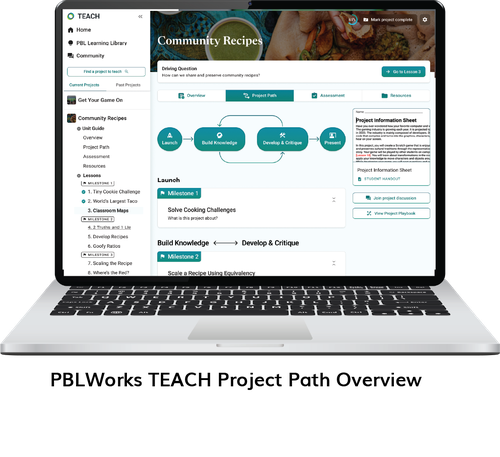
PBLWorks TEACH combines an intuitive UI/UX with research-based instructional design to support teachers in implementing high-quality Project Based Learning units for students. Its clean, visually organized interface provides easy navigation, embedded resources, interactive templates, and progress indicators, enabling teachers to access materials and professional learning efficiently. Instructional design principles include scaffolding, chunked modules, just-in-time learning, and opportunities for reflection, all aligned to PBL’s core elements: sustained inquiry, authenticity, student voice and choice, reflection, and public products. The platform also supports customization, reducing prep time while boosting teacher confidence and fostering engaging, student-centered learning experiences.
What users are saying:
TEACH is helping educators re-invigorate teaching and engage students more deeply in learning.
“The PBL units are incredibly interactive! Much of the content I've encountered in the past has been very surface-level, but the PBL unit I implemented allowed us to dive deeper into sources. As a result, these learning experiences have significantly elevated my students' writing and critical thinking skills. Additionally, the flexibility of the units provides ample opportunities for creativity." – Brook Rajnowski, a social studies teacher at Blevins Middle School in Fort Collins, Colorado
“I was really intimidated by the idea of making my own project. Having TEACH and the projects already made so I can just implement it is amazing. The students are using positive and negative numbers to add and subtract and multiply, but it’s not always the most interesting. [Using the TEACH project, students will have] a video game to design or remix, and they will be able to do the content I need them to do, but in a way that will be fun for them. It will be a great way for them to learn the material.” – Saul Zippin, a teacher at The Saklan School in Moraga, California.
“On the first day of the Community Recipes project, we gave students ingredients to make cookies without instructions. Watching them problem-solve, draw conclusions, and work things out without my help was incredible. They were already using their knowledge of ratios, just presented differently, and that allowed them to express what they knew in such an engaging way! Students connected with each other, their families, and even their cultures. I invited students to bring in a family recipe that had been passed down through generations. Some shared meaningful recipes from places like Ukraine. For those who struggled to make that kind of connection, we pivoted—they chose a favorite food and researched a recipe for it instead. It was a small shift, but it led to powerful moments of connection and storytelling. What started as a math unit turned into something much deeper, full of meaningful conversations and moments of connection that helped me understand my students in a whole new way.” – Robin Lasko-Brodeur a teacher from Westfield Public Schools in Massachusetts