
Most schools have “gone digital” in form, not function. Adding Generative AI will only exacerbate a very key problem: tech is used currently by 90% of teachers to automate analog actions, not to change the nature of the work. Teachers still author lessons 1–5 times a week, assemble materials, prove alignment to maps/standards, sometimes upload to an LMS or framework office suite, then deliver whole‑group instruction. This is digitization, not “going digital.” Tech is doing materials distribution and communication and that’s about it.
Meanwhile, high‑quality courseware—coherent, standards‑aligned, adaptive, and data‑rich—gets sidelined because of a myth that it is “doing the teaching” or “too expensive” (versus every teacher building every lesson from scratch?), or because the system treats courseware as supplemental or remedial only. The result is teaching is overburdened with compliance. Teachers remain the “source” of the knowledge pieces and resort to mostly lecture-style delivery when science has already proven it is not the best method today. Teacher prep and planning for lessons leaves far less time for true personalization and deemphasizes the many needed human skills teachers have in diagnosis, empathy and direct instruction to individuals.
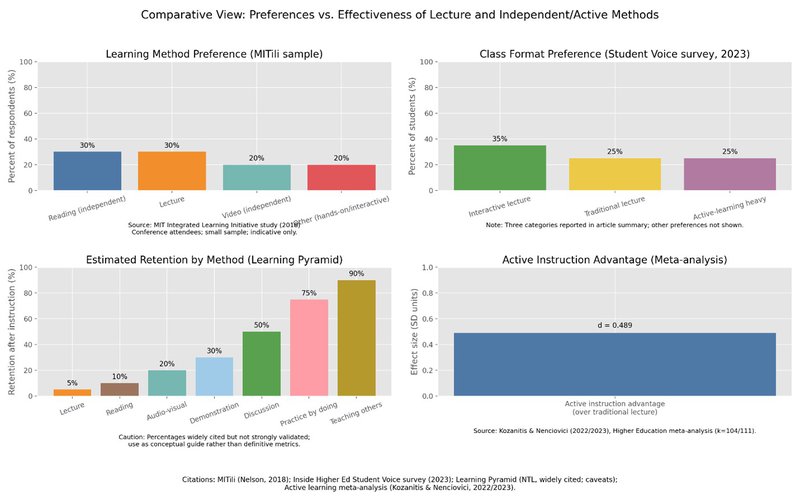
Here’s what research says about interactive courseware effectiveness compared to traditional lecture:
| Approach | Effectiveness vs Lecture |
|---|---|
| Interactive digital modules (courseware) | Significant improvement in performance & retention |
| Smart interactive tools (quizzes, feedback) | Equal or better than face-to-face; higher engagement |
| AR / VR / Mixed Reality environments | Large positive effect (AR strongest) |
| Gamification | Large effect on achievement & retention |
| Generic digital tools without interactive design (digital frameworks, documents & links) | Minimal or no improvement |
The Bottom Line: It’s time to elevate high quality courseware and AR/VR/Gamification in all K12 learning, transform the teacher’s role, and layer in Time AI for dynamic, pace‑based cohorts before adding in Generative AI.
This condensed model proposes two shifts:
- Courseware‑first with teacher as orchestrator—teachers stop being the content bottleneck and instead run routines for data‑driven grouping, mini‑lessons, conferrals, and performance tasks.
- Layer Time AI—move from block schedules to pace‑based, course‑centric micro‑lessons preferably delivered in courseware with live teaching intersected throughout the course. Time AI auto‑cohorts students the moment enough complete a study step, triggers short live sessions into the time blocks held on a teacher calendar teacher and flexes cohort size to minimize wait times. Note that with Time AI, classrooms are now used as meeting space only when called for, not routine linear schedules. Teachers roam when not in a class meeting to check on students in homerooms overseen by paraprofessionals or a rotation of teachers.
Together, schools unburden teachers from weekly lesson production, reduce wait times between learning steps, and scale personalization—often freeing up to 50% of teacher time and increasing capacity without sacrificing quality.
The Problem with how it’s Done Now: Digital on the Surface, Analog at the Core
- Unit pacing, fixed calendars: Districts set units and timelines for all students; teachers must deliver within rigid windows. Leaders lean on teachers as the entire pivot point for learning and personalization.
- Lesson production burden: Teachers write frequent lessons, collect materials, prove alignment, run discipline, managed an average of 30% mixed-ability and IEPs by writing at least ten adaptations to every lesson, provide absent students with make-up materials, do all testing and grading, coordinate projects, and much more. The list of burdens is enormous and not really a human job when a teacher is caring multiple units.
- LMS as distributor, not engine: PDFs, links, and videos flow through portals; coherent courseware is treated like “just another resource” rather than the primary instructional system.
- Whole‑group dominance: Personalization is aspirational, bracketed by age and grade bands plus class sizes and staying roughly on a pace forward together; reality is median‑pace teaching with light differentiation.
Reframing the Teacher’s Role
- From author to orchestrator of learning:
Teachers orchestrate students through the pre-built course pathways, run short mini‑lessons using any teaching method they prefer for that particular intersection with small groups coordinated alongside the courseware, confer 1:1, and coach performance tasks, all guided by live data. Teachers adapt interventions instead of writing new lessons weekly.
Classroom rhythm (courseware‑first)
- Concept Launch (5–10 min): frame the “why” and success criteria.
- Courseware Pathway (25–35 min): adaptive practice and formative checks; teacher scans dashboard.
- Mini‑Lessons / Small Groups (15–20 min): based on live flags (misconceptions, mastery gaps).
- Performance Task / Transfer (10–15 min): apply, justify, critique; build depth.
- Exit Checks & Conferrals (5–10 min): reflect, plan next step; teacher logs notes.
Why this works: Coherent courseware encodes alignment and mastery checks; teachers invest time where human judgment matters—diagnosis, feedback, and transfer.
Myth Busting (Brief)
- “Teachers will be replaced.” No—teachers become orchestrators, diagnosticians, and coaches. Courseware delivers content; teachers deliver judgment and feedback.
- “Courseware is just drill.” High‑quality courseware integrates explanations, formative checks, adaptive practice, scaffolds, and actionable dashboards.
- “We lose creativity.” Creativity shifts to performance tasks/projects and daily talk routines; Time AI’s pacing frees time for deeper work.
- “Compliance will suffer.” Compliance is automated: alignment, pacing, mastery, attendance/logs from micro‑lessons and interventions.
Conclusion
Schools won’t achieve genuine digital learning by uploading better PDFs. The breakthrough is structural: put courseware at the center, transform the teacher into the orchestrator of personalization, and then consider letting Time AI convert block schedules into pace‑based micro‑lessons that form exactly when learners are ready. After that, incorporate Generative AI to make every learner’s path “liquid,” going from a static courseware to augmented and recommendations into other modules of courseware or AR/VR immersive learning objects.
Unburden teachers, cut wait times, and scale high‑quality learning—so students progress faster, deeper, and more equitably.