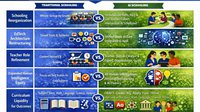
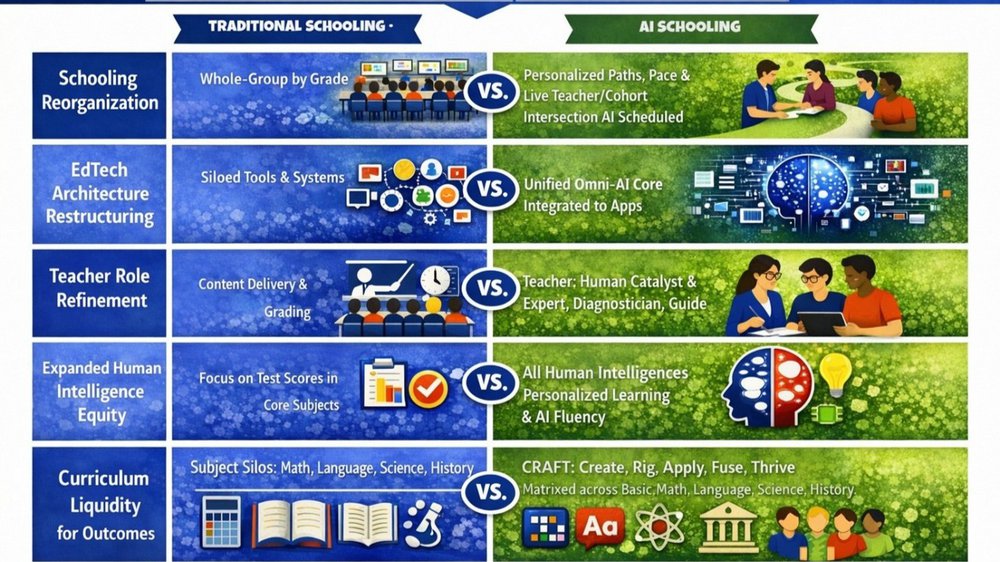
- Schooling Reorganization
- Edtech Architecture Restructuring
- Teacher Role Refinement
- Expanded Human Intelligence Equity
- Curriculum Liquidity
Across the country, schools are experiencing a steady erosion in enrollment. Families are choosing alternatives—micro‑schools, homeschooling, learning pods, hybrid academies, online providers, tutoring networks—because traditional schooling feels increasingly mismatched to modern life.
Meanwhile, artificial intelligence has entered the scene with breathtaking speed, causing leaders to retreat into familiar instincts: roll back tech, reduce student screen time, contain AI to classrooms as a basic “tool” teachers can use.
This instinct is exactly backwards once you understand what is at stake for the students who will graduate into a world of AI anyway.
AI is not another add‑on. It is not a gadget or a supplemental program. It is a paradigm shift greater than the sum of all previous technologies combined because it competes directly on intelligence.
AI forces schools to make a fundamental choice:
Decline—or niche down into the deeply human realms where machines cannot go.
When you resist the full spectrum of what AI can do in schools, thinking it’s a question of restraining students only when actually it’s far more expansively whole-operation reorganization, what you are doing is resisting being human.
AI allows a narrowing of what the humans have to be doing to orchestrate teaching and learning. It can manage time use, space use, distribution, customization of materials, pace, individual learner path, personalized recommendations, research, workflows and automations. All of these things “niche-down” what the humans have to be doing, allowing them to be human as their essential institutional responsibility to learners.
When AI agents are done right, humans are kept in-the-loop for just the points where humanity shines. AI doesn’t need to be “doing the teaching,” it needs to bring to fruition role precision to the act of teaching.
The shift to leaning heavily on AI, no matter it’s foibles, opens a path for schools to regain relevance, purpose, and enrollment. By not suppressing AI, schools can reorganize through it and isolate/elevate what only humans can do. When schools take the right perspective, AI becomes the long‑awaited infrastructure that enables the human‑centered learning experience leaders have always wanted but could never operationally sustain because too many tasks were piled on teachers.
The following five transitions show how schools can move from decline to renaissance.
1. Schooling Organization: From Whole‑Group Instruction -- To Personalized Paths & AI‑Scheduled Human Support
Traditional schooling organizes learners by age and moves them through content at a fixed pace. This structure suppresses the diversity of human ability across the revised nine human intelligences, which include not only linguistic and logical skills but interpersonal, intrapersonal, formational, motional, naturalistic, incorporeal, and ethical domains.
AI makes something new possible: A personalized path for every student, with AI continuously adapting pace, identifying readiness, and scheduling teacher or cohort interactions at regular intersections necessary to the human community skills creation that has to be a major emphasis in the Age of AI.
So AI doesn’t replace teachers—it narrows the use of human teaches to be more human, placing their expertise where it has the highest impact rather than using teachers as timekeepers and whole‑group flow-of-work shepherds. AI handles orchestration, while humans handle nuance, ethics, meaning‑making, and contextual interpretation.
2. Edtech Architecture: From Fragmented & Tiered Utility -- To a Unified Omni‑AI Infrastructure
Most schools today operate a patchwork of disconnected apps and systems. Teachers manually distribute materials, track assignments, move data between platforms, grade work, and manage workflow. This burdens educators with mechanical tasks that AI can now do better and faster.
The AI transition requires a Unified Omni‑AI Core—a single intelligent system that integrates all apps, content, diagnostics, and scheduling. Instead of teachers piecing together tools, AI acts as the central brain orchestrating all activity.
The Learning Counsel’s framework highlights that humans possess a time‑governed ethical intelligence—a governance function that AI lacks. Thus, AI should manage workflow and logistics, while humans provide judgment, oversight, and ethical reasoning
When operational load is lifted, educators can finally focus on human development, not clerical labor.
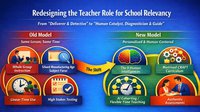
3. Teacher Role Refinement: From Content Deliverer -- To Human Catalyst, Expert, Diagnostician, Guide
For over a century, the teacher’s role has been shaped by the limits of mass schooling: delivering content, maintaining discipline, grading work, and enforcing schedules. These functions survived not because they are ideal, but because they were necessary under industrial constraints. A teacher is defined by being a manager of whole groups. That is what is pictured as the act of teaching. AI can disassemble whole groups into small cohorts who are at the same point getting meaningful and cognitively correct levels of instruction at the right moment. Teachers aren’t having to manage large groups who are at different levels of ability, only moments where every student is at the same point or a single student with a specific need. This is a major game-changer for the role.
The definition of what a teacher is relies on being an organizer, expert and deliverer of content, when all of these things are now done easily by AI. Keeping the job defined traditionally harms the elevation of human teachers catalyzing learning, diagnosing difficulties learners may have, and dozens of other things that architect personalization.
Now, teachers can be deployed precisely for their human qualities:
- Deep cognition and intuitive insight
- Ethical judgment and real‑time decision‑making
- Curiosity‑driven inquiry modeling
- Creativity and original thinking
- Emotional resonance and group attunement
These are the Uniquely Human Characteristics identified in your research—creativity, conscientious focus, cognition, curiosity, and emotional resonance—that no machine can authentically replicate. And they make the role of being a teacher easier because that is what a human teacher is: a human.
Teachers no longer need to spend their energy as content broadcasters or workflow machines.
They become experts in human development, catalysts who activate the full range of student intelligences.
4. Expanded Equity: From Test Scores Focused on Math & Language -- To Elevation of All Human Intelligences and AI Fluency
Traditional schooling evaluates students mainly by math and language output—ironically, the two domains where AI now excels. Continuing this focus will make human learners appear increasingly inferior to machines.
To remain relevant, schools must expand what they measure and develop:
- Outcomes based curriculum that incorporates subject basics
- All nine human intelligences (revised Learning Counsel 2025)
- The five uniquely human characteristics (Learning Counsel 2025)
- AI fluency, not just literacy—meaning the ability to direct, critique, and ethically govern AI systems
AI fluency prepares students not to compete with AI, but to co‑create with it, using AI as a force multiplier for human intelligence.
This repositioning acknowledges that human value lies in qualities AI does not have—and cannot develop.
5. Curriculum Liquidity: From Subject Silos -- To Dynamic Outcome‑Based Learning
Subject silos—math, language, science, history—were inventions of the manufacturing age. They make scheduling convenient, but they fragment human thinking, which is integrated by nature. The nine intelligences interrelate and activate simultaneously, not in 50‑minute blocks.
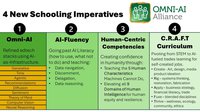
The AI schooling transition is grounded in teaching the basics within a dynamic and shifting set of tasks. A new ideal, the obverse of STEM which was subject focused, is CRAFT: Create, Rig, Apply, Fuse, Thrive —an outcomes‑based model that centers real work, real artifacts, and real understanding and would use the basics of math and language within the assigned learning.
AI makes using core subjects within the CRAFT ideals while also personalizing for individual students a simple task. And AI can still cause intersection with live teaching and fellow traveler students by keeping a baseline that isn’t deviated from for every learner, even though it is tweaking for interest or ability for each one. We expect teachers to do that right now, and it’s not a human job to manage such extreme complexity.
The CRAFT curriculum pillars are fit to all nine domains of human intelligence and the five characteristics that make humans different than machines. By building CRAFT curriculum as a matrix of existing subjects, which AI can easily do while also still meeting adopted academic standards and state testing compliance requirements, schools transition their entire operation.
Suddenly, AI handles complexity; humans handle meaning.
Conclusion: Decline or Human-Centered Renaissance
AI is not a threat to schools—the refusal to adapt to AI is.
Schools that cling to the old model will continue losing students. Those that embrace AI as infrastructure while niching down into deeply human intelligence will not only survive but lead.
The path forward is clear:
- Let AI handle the mechanical.
- Let humans specialize in the irreplaceable.
- Use AI to reveal and elevate every learner’s full spectrum of intelligences.
- Use CRAFT to produce outcomes instead of running subject silos.
- Redefine teaching as the most human profession in the world.
This is the education renaissance leaders have always hoped for, finally possible because AI can carry the weight that once made it impossible.
***