A new AI schooling model is emerging—one driven by human learning science and enabled by a special role for Time AI. This model transforms not only when learning happens, but where it happens.
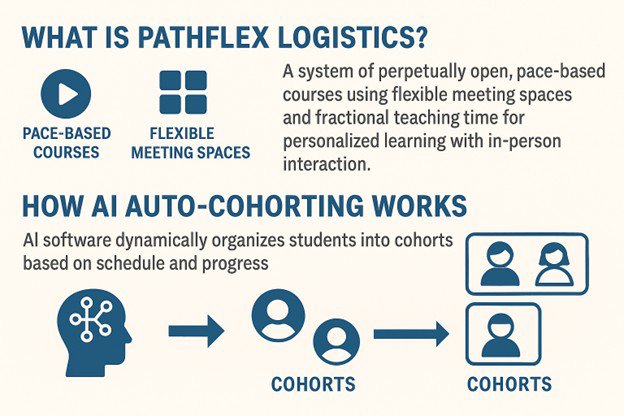
Pathflex Schooling—also referred to as AI Schooling—is a learning system that replaces fixed schedules and age-based cohorts with individually paced knowledge construction. Using AI, learners move along personalized learning paths while being dynamically synchronized into live instruction, mentorship, and peer collaboration at the exact moments when shared cognitive readiness occurs. Social learning is preserved and strengthened, not by calendar time, but by real-time alignment of understanding.
This shift is not merely a software upgrade; it demands a rethinking of school space as well, as it redefines education by making time flexible, learning personalized, and teaching precisely intersected—using AI to align students, teachers, and peers for live learning moments between points of independent study.
From Factory Layout to Learning Ecosystem
The traditional school design reflects its industrial heritage:
- Classrooms aligned along corridors
- Scheduled movement from class to class
- Bells dictating the rhythm of learning
- Teaching and study in the same time blocks and classroom space
This room-to-room, period-to-period design aligns with a calendar-driven model, not with how humans actually learn.
Pathflex Model: Zones, Homerooms, and Dynamic Spaces
In contrast, a Pathflex campus is organized around activity and cognition, not bells:
- Quiet Study Homerooms: Dedicated zones designed for individual focus and deep work, where learners engage with personalized tasks without distraction.
- Adjacent Loud Homeroom Spaces: Social zones for collaborative problem-solving, discussion, and peer interaction.
- Conference-Call Cubbies: Tech-equipped spaces for geo-distant live teachers or mentors to intersect with learners in real time if that subject’s teacher is not in-building that day.
- Less Classrooms Used as Interchangeable Meeting Spaces: Common areas that serve as class meeting spaces on demand as AI identifies natural cohorting points.
- Live teaching is segregated from independent study points. Each study is placed at a course level in every subject right for them.
- Every live class moment is a point of enrollment when the student indicates they have completed prior study or quizzes in the course’s lesson sequence.
- Each of those live classes pre-planned in the sequence of a course are cohorted by the AI onto the applicable student’s calendars only as they assemble, then resetting to accrue the next cohort before setting again as each set of students comes through across time.
This deliberate time and spatial redesign aligns with research showing that flexible learning environments support a broader range of collaboration and individual work and encourage learner agency when space mirrors pedagogical intent. (Springer)
What the Research Says About Flexible Educational Space
Emerging research and case studies suggest that physical space influences learning practices and outcomes:
- Schools adopting flexible learning spaces without fixed desks or static classrooms report enhanced collaboration, pupil agency, and interaction when the space is intentionally used to support new learning paradigms. (Springer)
- Systematic reviews of smart and flexible learning spaces reveal a global trend toward environments that integrate pedagogical, environmental, and digital dimensions to support modern instructional needs. (Springer)
- Higher education redesign efforts identify trends of human-centered and constructivist space design, where learning is not confined to scheduled rooms but spreads across campus contexts aligned with activity and social learning. (educause.edu)
These studies confirm that spaces designed for both collaboration and deep individual focus allow educators and learners to work in modes that align with cognitive processes rather than institutional rhythms.
Where Schools Are Already Shifting
Before Pathflex, innovators laid groundwork in both practice and space. Forbes has editorialized the idea that back to the future means back to the one room schoolhouse and multi-aged student collaboration. [Forbes - Why the One Room Schoolhouse is a Vision for the Future…]
- Teach to One (NYC): A mathematics program that uses multiple learning stations rather than traditional classrooms, where students engage with personalized playlists of activities and teachers orchestrate support as needed. Teachers are not doing classical “teaching” as in lecturing but doing more of a coaching aspect. They have a platform which gives each student a daily playlist as a system of customizing. (Wikipedia)
- Microschools: Often small and community-rooted, are experimenting with space and pacing that resemble Pathflex principles:
- They emphasize multi-age, mastery-based progression rather than fixed grades, allowing learners to circulate through activities at their own pace. (Institute for Self Directed Learning)
- Some hybrid microschool models function like modern one-room schoolhouses with multi-age groupings and fluid transitions between individual work and shared learning. (Dr. Hayes Educates)
- Microschools across the United States are expanding personalized and community-grounded schooling that places learner agency at the center, often supported by flexible use of space. (Getting Smart)
- Teacher-Centric & Hybrid “AI” Schools: Are symbolic of potential change but haven’t done the one thing traditional-model schools are resolute on and that is that there must be some live teaching. This is true because not all subjects or grades are the same.
- An AI school example is Alpha School (Austin, TX): A private school pioneering an AI-driven model where AI guides every lesson, customizing content and pace for students, leading to high achievement, but only nominally using teachers.
- Tool-using schools provide plenty of examples for the specifics of what AI can do in schooling without a model change that makes them applicable in the same way of totally personalized path and path that still intersects with live teaching. These include AI tutoring systems like Socratic (photo-based homework help) and Khan Academy (personalized practice), AI chatbots for writing feedback (Project Tony), automated grading tools (Gradescope), and virtual assistants for teachers to handle admin tasks, creating customized learning paths and freeing up educators for more hands-on teaching.
While these examples do not yet integrate all components of an Omni-AI at scale, their pedagogical flexibility and spatial innovation provide real-world proof points for the viability and benefit of Pathflex learning ecosystems.
An AI school using the types of AI and their own unique curriculum mix with live teachers in the Pathflex ideal goes beyond best practices isolated to within a teacher-centric by-age and by-class and course factory movement to systemic redesign.
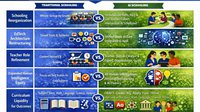
| Dimension | Factory Learning Layout | Pathflex Learning Layout |
|---|---|---|
| Room Purpose | Fixed classroom per subject | Homerooms and zones by activity |
| Movement | Scheduled class transitions | AI-triggered cohort movement |
| Quiet Space | Within silos of classes | Dedicated quiet homerooms |
| Collaboration | Planned class meetings | On-demand dynamic collaboration |
| Teacher Location | In classroom of record | Anywhere with conference cubbies |
| Tech Integration | Supplemental labs | Core in every zone |
| Cohort Formation | Age/class roster | AI-matched by cognitive readiness |
The emerging Pathflex schooling is not simply a new curriculum or an instructional tactic—it is a spatial and temporal redesign of schooling itself. Its physical environments mirror its learning logic: learner-centered, AI-aligned, and flexible by design.
Schools that are already experimenting with flexible spaces and personalized pacing offer a preview of what broader adoption can accomplish. The addition of Omni-AI and Time AI completes the system—making space, time, and instruction responsive to when and how humans actually learn.
***