
For more than a century, schooling systems, curriculum standards, and IQ testing have emphasized a narrow band of human capacity—primarily linguistic and logical-mathematical reasoning. These measures once served an industrial economy. They no longer serve a civilization now coexisting with artificial intelligence.
AI systems already exceed human performance in narrow logical, computational, and language tasks. Yet schooling continues to double down on exactly those capacities, while neglecting the broader constellation of intelligences that define human judgment, creativity, ethics, perception, motion, and meaning. The result is a growing mismatch between how humans are measured, how they are taught, and what the future actually demands.
This whitepaper argues for a New Education Imperative: education must explicitly teach, assess, and cultivate the full spectrum of human intelligence—for both learners and educators—if humanity is to thrive alongside AI rather than be diminished by it.
Building on and revising the work of Howard Gardner and earlier intelligence theorists, this framework defines nine distinct but interdependent human intelligences, reorganized for clarity, governance, and relevance in the Age of AI. For the first time, the domains of intelligence are matched with the main channels of human thought.
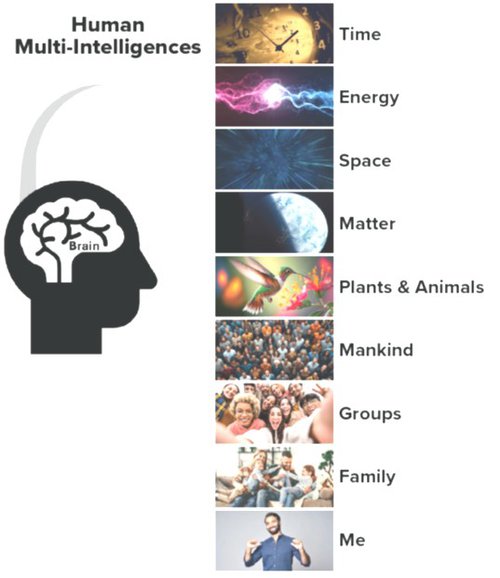
We think across these Channels:
- Individual
- Family, Small Group
- Groups, Nations
- Mankind
- Plants, Animals
- Matter
- Space
- Energy
- Time
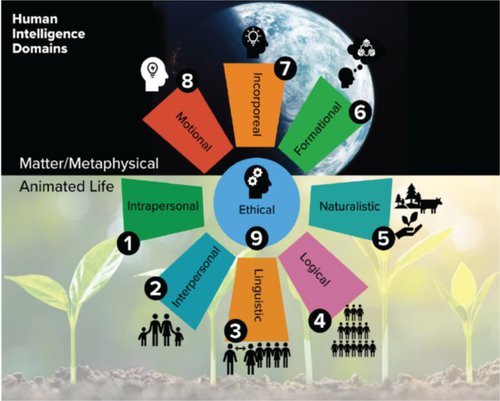
Our corresponding Domains of Intelligence are:
- Intrapersonal
- Interpersonal
- Linguistic
- Logical (Mathematical)
- Naturalistic
- Formational
- Incorporeal
- Motional
- Ethical
The “channels” represent the rough groupings the mind does for all thinking -- estimating how much time things will take, how much energy and space is needed for, say, moving some dense matter like a heavy pan or a rock, and all the effects on animated life in categories for our actions. The intelligences correspond not merely to academic skills, but to how humans think in relation to life, matter, space, energy, and time. They represent the complete operating system of human survival, creativity, and moral decision-making.
Critically, this model identifies Ethical (time-governed) intelligence as the executive function—the governor that adjudicates all other intelligences. This distinction becomes existentially important as AI systems, which are inherently non-living and non-biased toward life, increasingly influence decisions at scale.
In the Age of AI, then, Humans must become more—not less—conscious of their own intelligence architecture.
The implications for schooling are profound:
- IQ testing must expand beyond narrow proxies and evolve into multi-intelligence assessment. In the absence of this, educators must at least be aware of the full context of the nine different intelligences and begin to recognize them in themselves and students.
- Curriculum must move from standardization to intelligence-aware personalization.
- Teachers must be trained not only to deliver content, but to recognize, develop, and orchestrate diverse intelligences in learners and in themselves.
- Education systems must explicitly prepare students for human–AI collaboration, not competition.
This is not an abstract theory. It is a practical blueprint for redesigning schooling around the full reality of human intelligence —so that education becomes the engine for a more capable, ethical, and adaptive humanity.
Introducing the 9
Humans think first with the element of time, which is the Ethical intelligence domain and the governor of the other eight intelligences. This is because time is the only constant inconstant, always ticking forward. Every decision we make is through this lens first, adding in the other eight channels of thought and intelligences from that central awareness. Time adjudicates how much energy and space we will use and how involved the other element of matter is or will be, and how to bring in or leave out other animated life including self. For example, a boulder in the way of our drive is stably still there second after second so we assess how much force will be needed to move it out of the way, and if we have the maneuvering room to do that (space), it’s form (matter), it’s weight (logic). Then we think with how other animated life might help, do we have a buddy who can shove it out of the way with us?
We “think” also without making decisions, though always assessing impacts of things happening to each of the channels. Our minds use quantities -- logic, math -- to weigh impacts on self, on our family, on our work or team group, on all of mankind, on plants and animals, and so forth.
The mind also uses words to define qualities and to label things to classify the world around itself to make living and organizing easier.
Time is a measurement against which all other decisional ingredients are entered in or not, so it adjudicates and applies a sort of instant personal ethic to determine the best way forward. It was found that by increasing time perception, time management or decision-to-not-manage time, can play a large part in increasing IQ. When a person upskills in time awareness, they are coincidentally increasing awareness of all the other domains and therefore all intelligences.
Notice as well that the first five channels represent animated life. The last four are the elements and are arguably non-animated things except at the molecular level of electrons spinning. Time is the only one that almost sits outside of all the others as not really a thing and not a sentience -- it is motion (energy) of matter through space and is perceived by life as change. It is more accurately a condition than an element.
Notice that AI would be on the unalive side of what can be envisioned as a wheel of human intelligences with the governing ethical mind at the center. AI is born of a machine. The human mind is on the alive side with a pre-bias for life. This is one of the first things to be aware of regarding AI -- it must be trained to weight all decisions like we do -- for the survival of life.
What follows is a practical mapping of how each intelligence manifests, how it is expressed, how it fails when underdeveloped, and why current IQ systems mismeasure it.
Animated Life
| 9 Domains of Intelligence | 1 | 2 | 3 |
| INTRAPERSONAL | INTERPERSONAL | LINGUISTIC | |
|---|---|---|---|
| Thought addressed to survival of: | Individual Self | Family, Small Group | Groups |
| Description | Awareness of self. Having an identity, having a corporeal body, interior processes and thoughts, emotions (motions within) and feelings. | Awareness of others. Sociability, high acuity for culture, manners, fashions, relationship modes and methods. | Awareness of language qualities. Assigning meaning with symbols, words, expressions; defining and making sense of things in orderly spoken and written communications. |
| Enactments | Health focus; what drugs, vitamins, foods, medical conditions, hygienic and beauty care. workouts. Food connoisseur. Physical dexterity. | Focuses attention on relationships with others, news and trends; what interpersonal relations are and how people relate. "Follows" others on social media and considers their opinions. | Precision of language and punctuation focus, providing the right expression; what meaning from words and texts including lasting emotional impact and establishment of understanding. |
| Skills | Introspection, distinguishes own thought from others' input, self-regulation, self-motivation, resilience, emotionally-intelligent, hygienic. | Initiating conversation, being welcoming for others, interest in others, dynamics and politics of relationships. Sharing, cooperation. Empathetic. | Reading, writing, comprehension, assignment of meaning, fluency. Frequently narrating and evaluating meaningfulness of outside-of-self life, even if only internally. Eloquent. |
| Perceptions | Own emotions and interpreting them. Limits of strength, flexibility, body safety, bodily processes, pains, and cycles. | Emotional undercurrents between self and others, others with others. | A dimensionality to words/symbols beyond definitions alone, words are dynamic. |
| Time Sense | Daily routines, hours sense. | Weekly motion of time as in "Today is Monday, 2nd week of April." | Monthly sense of time with attention to seasons, attaching language-like meaningfulness to months as in "Fall colors" and so forth. |
| Difficulties if concentrated in this intelligence (gifted in this domain) | Doesn't understand how others cannot self-regulate, understand their emotional states, keep themselves healthy. | Doesn't understand how others can be unaware of others' feelings, their lack of sociability, culture, fashions, manners; takes action to focus attention here when it may not be wanted and even considered trivial. Often distracted from productive actions into worry about relationships only. | Doesn't understand how others don't "get it," how they do not experience another's mind in stories or see multiple interpretations; difficulty "dumbing down" own comprehension for others. Feeling separate from others; retreats to reading, writing, observing. |
| Low or absent this domain intelligence (struggling in this domain) | Little personal responsibility, uncoordinated, accident-prone, neglect of hygiene. Difficulty discerning own thoughts from remembered words spoken by others. | Cannot make friends or assumes they cannot. Does not initiate conversation, unaware of manners, culture, fashion, others' desires or motivations. | Low literacy or no interest in words/symbols as meanings in life. Possibly more visual (incorporeal intelligence) or auditory (motion/wavelength intelligence). |
| Likely favorite labor fit | Some athletes, doctors/surgeons, nurses, pharmacists, dentists, law enforcement, retail and manufacturing line work, drivers, electricians, plumbers, construction workers, agricultural workers, butchers, machinists. | Counselors, service workers, stylists, hygienists, cosmetologists, barbers, fashionistas, bloggers, ministers, parents, campaigners, marketers, trainers, teachers, managers, salespeople, human resources staff. | Authors, publishers, librarians, teachers, marketers, clerical, literary agents, lawyers, historians, politicians, AI scripters. |
| IQ Testing | Not tested | Not Tested | Tested |
| Animated Life | Animated Life | Physical/Metaphysical Universe Elements | |
|---|---|---|---|
| 9 Domains of Intelligence | 4 | 5 | 6 |
| LOGICAL | NATURALISTIC | FORMATIONAL | |
| Thought addressed to survival of: | Mankind | Plants, Animals | Matter |
| Description | Awareness of quantities. Categorization of people and things, numbers and symbol placeholders, mathematical dexterity, a propensity to network ideas into taxonomies, assemble, distribute and partition. | Awareness of other life forms. Symbiosis with plants and animals. Sense of inclusion and self-extension in other life and nature. | Awareness of structure and form. Drawn to science, pattern, relational and systems thinking with analytical creativity and materials grounding. Extension of self into all things. |
| Enactments | Noticing amounts of things, sequence, and logic patterns, trends, relationships. Will seek mechanisms or disciplines to bring nuance to their awareness of quantities like statistical analysis. | Connecting with animals, plants, weather, seasons, life-cycles; noticing planetary and universe forces -- stars, clouds, topology. | Causes, interrelationships. Builds organizational charts, architectures, routes. Efficiency/priorities. Unstructures to restructure. |
| Skills | Solving mathematical problems, understanding graphs, percentages, fractions and quotients. Documenting and winnowing out facts from emotions. Bringing orderliness to environments. | Having a "green thumb," tracking with weather and daily temperatures, interest in life-cycles, predator-prey, forest fire renewal, major and minor forces and cycles. | Builds 4D geometric forms in mind space. Ability to see material and human dynamics in abstraction; creation of forms, schemas, transformation of matter. |
| Perceptions | Imagines the world mathematically, conceptually, maybe even algorithmically, sees beyond flat numbers and equations. | Sensitive to non-human living things and natural cycles as part of their mind's domain. Never feels alone because of other nearby plant or animal life and all matter. | Might be able to describe what they construct in their own minds as organic logical forms that they can “see” and “feel” as dimensional including density. |
| Time Sense | Time is "speeded," sensed as years, a disregard of time as a sort of inverse of being quantity oriented because time is infinite. | Time sense is past and future, not present time. Concern for past natural orders, bringing future naturally. Tides, growing seasons, moon cycles, etc. | Present time sense is fractional, according to clocks and calendars, each unit having dimension within a larger construct. |
| Difficulties if concentrated in this intelligence (gifted in this domain) | Doesn't understand how others can be unaware of vast or no quantities to things or the troubles of mankind in disproportionalities. Uncomfortable in disordered environments, feeling "behind" in mathematically mastering every part of life into summations. | Doesn't understand how others are not aware of all that is happening naturally as if those forces are an extension of self; animal and environmental harm incomprehensible; self feels large and dispersed into the natural world. | Doesn't understand how others do not recognize a truth because of facts. Prone to over-simplify for others; or may overly complexify to overwhelm others. May annoy with their need to address and correct forms/organizations and behaviors. |
| Low or absent this domain intelligence (struggling in this domain) | Difficulty bringing order and logic, thinks and converses non-sequentially, comes up with wrong answers to math problems, reads graphs wrong, money problems. | May be unconcerned about throwing trash just anywhere. Disregard or ill-treatment of animals, plants, unaware of weather, lack of interest in natures processes and symbiosis, dislikes the outdoors. | A follower and observer rather than manipulator of forms or systems, low energy to address correction of workflow, doesn't see inefficiencies, forms of things and confuses chain-of-command in organizations. |
| Likely favorite labor fit | Physicists, coding/programming, statistician, mathematician, scientist, clerks, auditors, financial analysts, investors, data technicians, actuaries, economists, engineers, teachers, house cleaners, business managers. | Farmers, conservationists, trade, parks and recreation, animal husbandry, research and practitioners in health sciences, ecology, cosmology, astronomy, biology, geology, meteorology, oceanography and others. Chefs, cooks. Herbalists. | Coordinators and logistics workers, builders, architects, fabricators, mechanics, machinists, user interface/user experience software designers, interior designers, packaging designers, lawyers, data modelers, consultants, inventors. |
| IQ Testing | Tested | Not tested | Partially tested alongside math |
Physical/Metaphysical Universe Elements
| 9 Domains of Intelligence | 7 | 8 | 9 |
|---|---|---|---|
| INCORPOREAL | MOTIONAL | ETHICAL | |
| Thought addressed to survival of: | Space | Energy | Time |
| Description | Awareness of dimension. Visual-spatial orientation with extension of self to any/all space, seen/unseen forces. Extrasensory 4D information collector ; thought origination or knowing from no data. | Awareness of motion. Includes awareness of no-motion, raw energy, all wavelengths; oriented to the kinesthetic, to musical aesthetics, to infinity-scale rather than two-factor logic (right/wrong). | Reason and governance of the other intelligences for a decision or production of an effect, concerned with survival/achievement. Mindfulness of time as the only constant inconstant. Curiosity. |
| Enactments | Principled, goal setting, creating or appreciating art and athleticism. Expressing originality, creativity. Locates lost things easily. Values silence, can be a loner, work independently. | Spontaneously energetic or laid back at will. A starter, gamesmanship through sides, rules, fields-of-play, anticipatory moves and also unmaking-of-games by no-opponent, no-field, nullness of rules. Mimics others easily. | Considers penalties and rewards of action and inaction, engages various areas of their other intelligence domains. Takes right actions at the right times. Likes to adjudicate. |
| Skills | Information curation, goal design, defining principals, isolating own thoughts as distinct from others. Constructs in mind space highly unique organic forms. Sympathetic. | Listening skill, music creation and appreciation, use of efforts physically (athletic) or mental discipline (focusing attention, speed-of-reasoning). | Good decisions. Data literacy. Extrapolates data and weighs importances, sees beyond the now to consequences for all the channels of thought from Energy down to Self. |
| Perceptions | Metaphysical and extra-perceptional conclusions are sometimes "leaps of faith," mystical, but often correctly predict or align facts and outcomes. | Hearing sound distinctions, pauses and no-sound, feeling energy of environment and others and drawing into self or emanating it out. | Noticing discord or new potential, applies the other intelligences. |
| Time Sense | Sense of infinite time and no-time at all. Can possibly imagine being "outside of time." | Can seen to "slow" time by focusing to one motion & hindering awareness of other motion. Perception windows of only present time, only past or only probable future at will. | Precision sense of time down to minutes, seconds or extremely broadly out to infinite future. Time management. |
| Difficulties if concentrated in this intelligence (gifted in this domain) | Doesn't understand how others cannot expand mind-space, cannot feel guilt, are uncreative, are unnecessarily noisy, can't find lost items or craft good AI scripts. Questions everything. Experiences persistent guilt for bad actions unless rectified. | Doesn't understand others not thinking fast or disliking dancing. Poor sportsmanship. Has to start new efforts (games) in life constantly. Utilizes infinity-based logic tied to awareness of infinity of energy wavelengths. | Doesn't understand how others cannot see when something will do more harm than good; how others will not act towards achievement and survival but undermine themselves, others, the world. Abhors subterfuge, hidden influence. |
| Low or absent this domain intelligence (struggling in this domain) | Unprincipled, little imagination because does not construct in mind space well, poor AI scripting/agent creation. Can't stand silence. Materialistic. Unquestioning follower, easily shamed and self-defensive. | Two-factor logic only -- things are right/wrong, black/white, up/down, only -- cannot switch to infinity-scaled logic with in-between realities; unmusical or only repetitious-beat relational, low energy or hectic but uncoordinated motion. | Misdefines ethics for self only rather than greatest good for all channels of life. Neglects other areas of intelligence, immorality, criminality, can't see consequences. Hides, lies, and won't work. |
| Likely favorite labor fit | Visual artist, graphic artist, crafts artists, counselors, philosophers, analysts, data architects, movie and show producers, script writers, actors, quality control, marketers, some athletes. | Musicians, music producers, game and interface designers, teachers, managers, coaches, athletes, dancers, martial artists, childcare, some athletes. | All management, human resources, lawyers, counselors, ministers, service people, clerks, human resources officers, governance. |
| IQ Testing | Partially tested as Visio-spatial | Partially tested as processing speed | Partially tested as reasoning |
Understanding the Revision
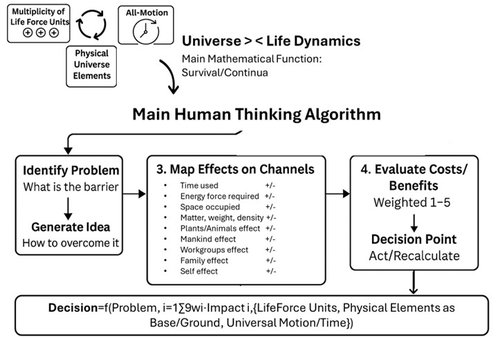
The Learning Counsel’s research found the actual mechanics of the human mind -- how we think and what our main mathematical function and governing algorithm is - not a cultural view or purely biological view, but as a comparison to machine logic.
After considerable analysis of types of AI, it was natural to revise Howard Gardner’s nine human intelligences, which were themselves derived from earlier authors L.L. Thurstone and J.P. Guilford. The purpose of researching AI was to project future convergence in education and to find how humanity could balance the arising capabilities of AI.
Note that Gardner focused on intelligence as a response to culture. The revision focuses on intelligence as a response to life force(s) and the physical universe. What was also missing was the overarching human motivational idea and a governance factor between the types of human intelligence. The original overlapped intelligences into less distinctive domains. In the Age of AI, there had to be more clarity.
The Main Human Thinking Algorithm
The human mind is posing this one question continuously and it’s quite mathematical: How many lifeforms and things will be positively versus negatively affected by an action I take?
Thus the mind is always counting. This is usually weighted to life-forms over the inanimate elements of the physical universe - mere things -- by humans. Humans consider the win ratio of the lifeform side more important. The effects of any decision on the elements of matter (as in access to a thing or sourcing or owning it, organizing or excluding a thing as a barrier), space (making room, how filled, how used, any lack of), energy (as in how much effort or raw electricity) and time (as in shortness or length of towards achieving the purpose and amount of attention and control needed), are secondary. This is why we think AI, because it is of a machine, is inferior -- we have a bias because of what we are and our natural thinking order.
The main mathematical function of the human mind is survival (continuance). This is the most basic of basic ideas. We’re trying to live. Our human thinking algorithm assumes this and then counts effects against nine channels of life, always running a cost-benefit analysis. It does so in a certain order unless there is a derangement.
Why This Matters Now
Artificial intelligence has reached a tipping point. Systems now generate text, analyze data, compose music, detect patterns, and automate workflows at speeds that surpass human capacity in narrow domains. Yet our schools continue to measure and reward primarily those same narrow domains—linguistic output and logical computation. When machines outperform humans in the very areas schools overemphasize, students understandably question their own value. The problem is not that humans are becoming obsolete; it is that education has failed to articulate and cultivate the full architecture of human intelligence.
New Dimension of Equity. Redefining intelligence restructures equity at the system level. Traditional schooling equates fairness with equal access to standardized content and uniform assessments, even when those assessments privilege linguistic and logical performance above all else. The result is not neutrality but concentration of status around a narrow cognitive profile. Expanding intelligence to nine validated domains shifts equity from access to content toward legitimacy of capacity. Multiple forms of strength—whether motional, naturalistic, formational, interpersonal, or ethical—are intentionally cultivated, measured, and advanced. This creates diversified pathways to excellence rather than a single academic bottleneck. In this model, equity is not remediation for those who fall short of one benchmark; it is structural recognition that human capability expresses itself through multiple intelligences that deserve institutional investment.
Student Well-Being in an AI-Saturated World. A narrow definition of intelligence does more than distort equity—it undermines identity. When students are measured almost exclusively by what machines now replicate efficiently, many internalize inadequacy rather than difference. In an AI-saturated environment, this psychological effect intensifies to the point that learners may compare themselves to systems that produce instant answers, flawless grammar, or rapid calculations, or overly rely on those, seeing AI as “smarter than me.”. A nine-intelligence framework counteracts this erosion by strengthening domains AI cannot authentically inhabit—ethical judgment, interpersonal nuance, embodied motion, principled decision-making, self-regulation, and meaning construction. Education then becomes a process of fortifying human distinctiveness rather than competing with automation. Students develop resilience, agency, and clarity about their unique value in a technologically advanced society. Personalization becomes developmental—building confidence across intelligences and reinforcing a stable sense of worth that is not contingent on outperforming machines.
Workforce Readiness. Outside of school, workforce structures are shifting. Routine cognitive tasks are increasingly automated, while demand rises for complex judgment, ethical reasoning, systems thinking, adaptive creativity, collaboration, and principled leadership. These capacities do not emerge from standardized test preparation. They emerge from intentional development of the full spectrum of intelligences—especially ethical, formational, motional, interpersonal, and incorporeal domains that current systems barely measure.
Humanity’s Safeguard. There is also a civic dimension. AI systems are being embedded into governance, media, healthcare, finance, and defense. Without a population trained in ethical time-governed reasoning—capable of weighing consequences across individuals, groups, nations, and the natural world—society risks delegating critical decisions to systems that do not possess a bias toward life. Expanding intelligence education is therefore not merely an academic reform; it is a safeguard for human continuity.
This moment demands action. If education does not redefine intelligence now, AI will define value for us. The New Education Imperative ensures that schooling prepares humans not merely to compete with machines, but to lead them—guided by a comprehensive understanding of what human intelligence actually is.
The Learning Counsel is a research institute and news media publisher with 310,000 readers and 1M+ podcast followers providing context for educators from ongoing analysis of trends and a deep understanding of technology, systems and school administration. Our mission-based organization produces regional meetings with research briefings and invites local educators to share good works with our national audience. www.LearningCounsel.com