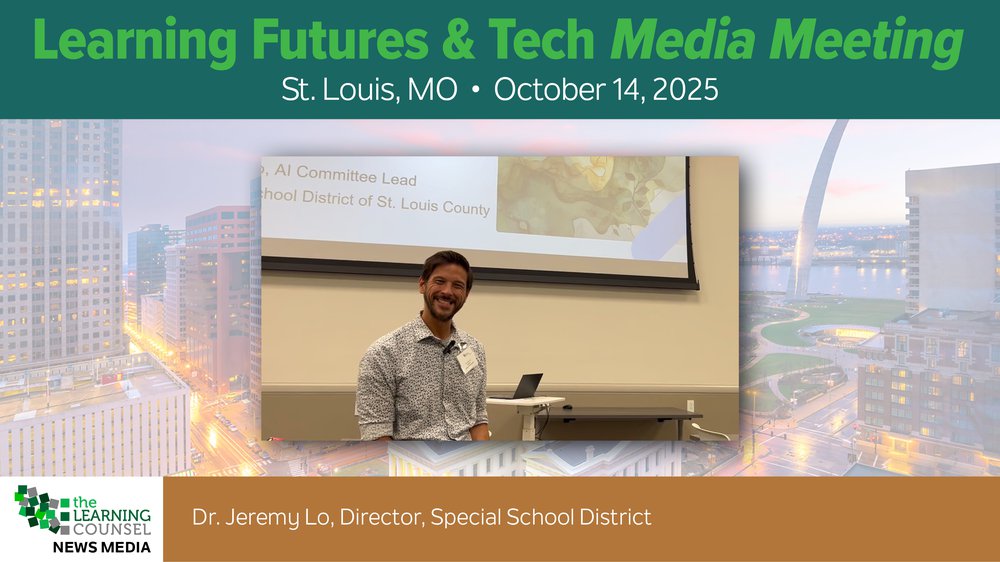
At the Learning Counsel Learning Futures & Tech Media Meeting in O’Fallon, Missouri, Dr. Jeremy Lo, Director of Special School District, delivered a deeply personal and thought-provoking presentation on how storytelling, cultural perspective, and adaptability shape his work in education and technology.
Dr. Lo began with a reflection on his own life, describing a journey that spans continents, cultures, and generations. “I grew up all over the place,” he shared, recounting his biracial family’s beginnings in Miami, Florida, and his early childhood in Singapore. He told the story of his parents’ unlikely meeting—his mother, a psychology student, and his father, a World War II survivor and architecture professor—highlighting the blend of determination, serendipity, and cultural influences that shaped his upbringing.
Eastern and Western Storytelling: Lessons in Perspective
Dr. Lo used his personal narrative as a gateway into a broader lesson on perspective and adaptation, contrasting Western and Eastern storytelling traditions. In Western storytelling, he explained, a story is structured around a hero, a climax, and a resolution. In contrast, Eastern plot structures, such as Singapore’s K Tetsu framework, emphasize a four-act structure where life happens, suffering occurs, and the focus is on adapting rather than conquering. “You are not the hero; you are part of a community,” he said. “The community helps adapt to the new reality.”
This perspective, Dr. Lo noted, profoundly influences his approach to education. “Whether we’re looking at special education processes or integrating AI into schools, the question is not just what we can change, but how we and our community can adapt to new challenges together.”
Integrating AI and Special Education
As the lead of his district’s AI committee and special education process, Dr. Lo emphasized the importance of collaboration and experimentation. His work involves exploring how AI tools can support students while aligning with the district’s values, particularly for those in special education programs. He highlighted initiatives such as rapid prototyping to test interventions quickly, ensuring students receive the most effective learning experiences possible.
“AI is not just a tool,” he explained. “It’s an opportunity for educators to reimagine how we support students, adapt to change, and create systems that center both human connection and technological innovation.”
Life Lessons for Education
Dr. Lo’s presentation was as much about life philosophy as it was about technology. By blending personal storytelling, cultural insights, and professional expertise, he encouraged educators to see challenges as opportunities for adaptation and growth. “Life happens, suffering happens,” he concluded, “but our task is to adapt—together, as a community, with compassion and creativity.”
Through his unique lens, Dr. Jeremy Lo reminded attendees that education, AI, and human development are inseparable from the stories we live and the communities we build, offering both inspiration and practical guidance for navigating the ever-evolving educational landscape.
Tune in below for the full presentation.