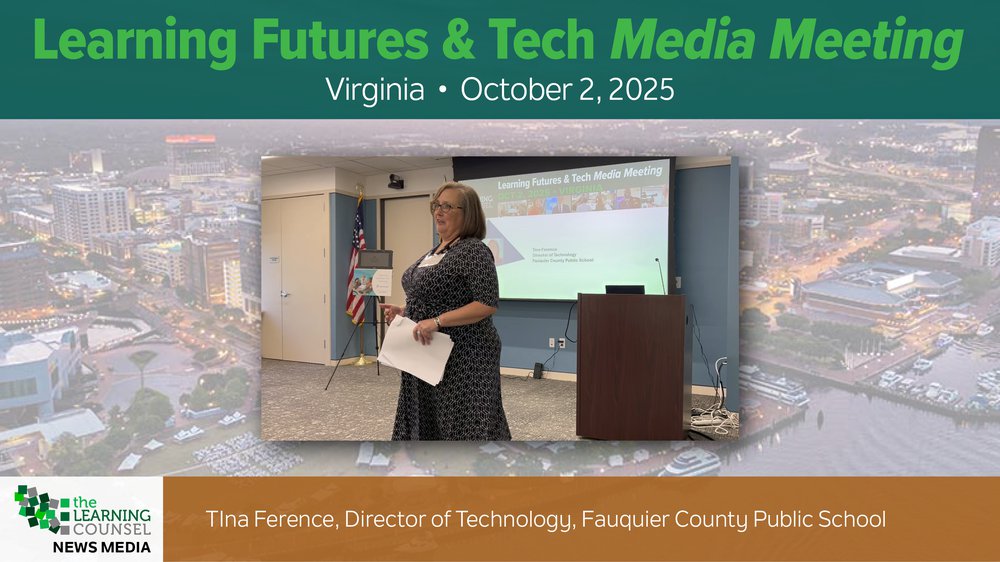
At the Learning Counsel’s Learning Futures & Tech Media Meeting in Warrenton, Virginia, Tina Ference, Director of Technology for Fauquier County Public Schools, delivered a grounded and thoughtful presentation on what it really means to support technology in modern K–12 education. Framed around the event’s theme of “challenges and innovations,” Ference explored how nearly every challenge districts face becomes the breeding ground for innovation—if approached with intention and empathy.
“I focused more on the challenges,” she admitted at the start, “but when you hear the whole story, you’ll see that these challenges are exactly what push us forward. They’re what help our teachers and our students become more innovative.”
From Overhead Projectors to One-to-One: A Look Back
Ference brought the audience back to 1994, her first year in the classroom—an era that now feels worlds away from today’s tech-saturated school environment.
Back then:
- Most classrooms had no computers.
- Access to technology meant fighting for time in the single computer lab.
- There was one technology cart in the entire school, with one laptop and one projector—if you were lucky.
- The overhead projector was the teacher’s primary instructional tool.
“Oh, and that computer lab?” Ference said with a smile. “There were no logins, no accounts, no data trails. You opened a program, made your map in MapMaker, printed it in black and white, and that was it.”
Even then, sustainability was a concern—keeping the one lab functional for an entire building was not an easy task. But the scope of technological responsibility was still relatively contained.
New Era, New Challenges
Fast-forward to today, and the landscape looks vastly different.
One-to-One Devices
With every student carrying a device, technology is no longer a rare resource—it’s an all-day presence. That shift has created a host of new expectations and new strains on district systems.
Screen Time
One of the biggest modern concerns? Screen time.
Students are on screens in school, at home, and everywhere in between.
“Our kids spend too much time on screens,” Ference acknowledged. “They go home, and it’s more screen time. So we have to fight that balance.”
Finding a healthy equilibrium between digital learning and human interaction has become a major focus for teachers and district leaders.
Modern Privacy Pressures
In the past, student privacy was protected by something as simple as a locked file room.
Today, things are vastly more complex:
- Sensitive information sits behind digital logins.
- Student data is accessible on multiple platforms.
- Staff must maintain strong cybersecurity practices around the clock.
“Now everything’s at your fingertips,” Ference emphasized. “Which means we have to protect accounts, safeguard systems, and ensure that our student information isn’t exposed.”
Challenges as Catalysts for Innovation
Though Ference’s presentation centered on the challenges, her message was ultimately one of optimism and direction.
Every challenge she named—device access, privacy, screen time, sustainability—has driven the district to refine its practices, improve training, harden security protocols, and innovate on behalf of staff and students.
Technology, she noted, has always come with barriers. What has changed is the scale and complexity. But one thing remains consistent: schools must continue balancing the educational promise of technology with the very real concerns it brings.
Ference’s work, and the work of her team, aims to do exactly that.
Moving Forward with Purpose
By the end of her presentation, attendees were reminded of how far K–12 education has come—and how intentional leadership will shape where it goes next.
Ference’s reflections served as a powerful reminder that:
- Challenges are not obstacles to avoid, but opportunities to evolve.
- Innovation doesn’t happen in spite of struggle—it emerges because of it.
- And balancing teaching and technology is not a problem to solve once, but an ongoing practice rooted in adaptability and care.
In Fauquier County, that balance is being pursued with clarity, honesty, and a commitment to supporting both educators and students in meaningful ways.
Tune in for the full presentation below.