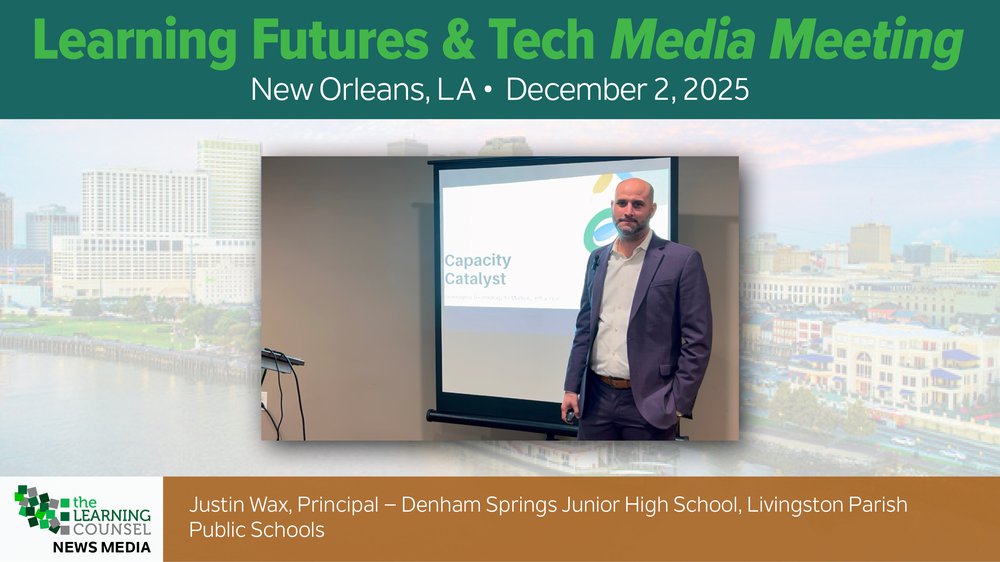
At the Learning Counsel Learning Futures & Tech Media Meeting in New Orleans, Justin Wax, Principal of Denham Springs Junior High School in Livingston Parish Public Schools, delivered a powerful message about leadership, technology, and the importance of building capacity in schools. Recently named the 2026 Louisiana Overall Principal of the Year, Wax shared his framework for using technology as a catalyst to expand influence, strengthen teams, and ultimately improve student outcomes.
Technology as a Multiplier—Not the Solution
Wax began by reframing a common assumption in education: that technology alone can transform schools.
“Technology can transform the things that we do, but technology alone doesn’t transform schools—capacity does,” he said. “When we build capacity in others, we multiply our influence and scale what’s working.”
At Denham Springs Junior High, a campus serving approximately 850 middle school students in central Louisiana, Wax emphasized that the real power of technology lies in how it amplifies people, systems, and culture, rather than replacing them.
The Capacity Catalyst Framework
Wax introduced what he calls the Capacity Catalyst Framework, a pyramid model designed to help schools systematically improve outcomes. The framework rests on three interconnected tiers: processes, people, and culture, all aligned toward the ultimate goal of student success.
1. Building Processes: The Foundation
At the base of the pyramid is the development of purpose-driven, scalable processes. These systems create consistency and clarity, ensuring that effective practices can be replicated across classrooms and teams.
“The goal isn’t just to have a great culture or capable people,” Wax explained. “The goal is improved outcomes—seeing students grow, succeed, and exceed expectations.”
2. Building People: Empowering Leaders at Every Level
The middle tier focuses on developing leaders throughout the organization, not just in formal administrative roles. Wax emphasized that empowering teachers, staff, and students creates a distributed leadership model where innovation and accountability thrive.
By leveraging technology to share resources, streamline collaboration, and expand professional learning, schools can accelerate leadership development and broaden their impact.
3. Building Culture: High Expectations and People-Centered Leadership
At the top of the pyramid is a high-expectation, people-centered culture that drives student success. Wax stressed that culture is not just about positivity—it’s about aligning beliefs, behaviors, and systems around the shared mission of improving student outcomes.
“When processes and people come together in a strong culture, that’s when real transformation happens,” he said.
Outcomes as the Ultimate Measure
Throughout his presentation, Wax returned to a central theme: outcomes matter most.
“Our goal isn’t just to build processes, develop people, or create a great culture,” he said. “Our goal is to change students’ lives—to help them achieve more than they expected and more than we thought was possible.”
By focusing on capacity-building and using technology strategically, Wax believes schools can scale success and ensure every student benefits from high-quality teaching and leadership.
A Call to Educational Leaders
Wax closed with a call for educators and leaders to see themselves as capacity catalysts—individuals who multiply impact by empowering others. His framework offers a practical roadmap for schools seeking sustainable transformation in an era of rapid technological change.
In Wax’s vision, technology is not the driver of change but the tool that accelerates human potential, turning strong leadership, effective systems, and positive culture into measurable gains for students.
If you want, I can also create a short conference recap version, a press-style news article, or a LinkedIn-ready thought leadership piece from this content.
Tune in below for full presentation.