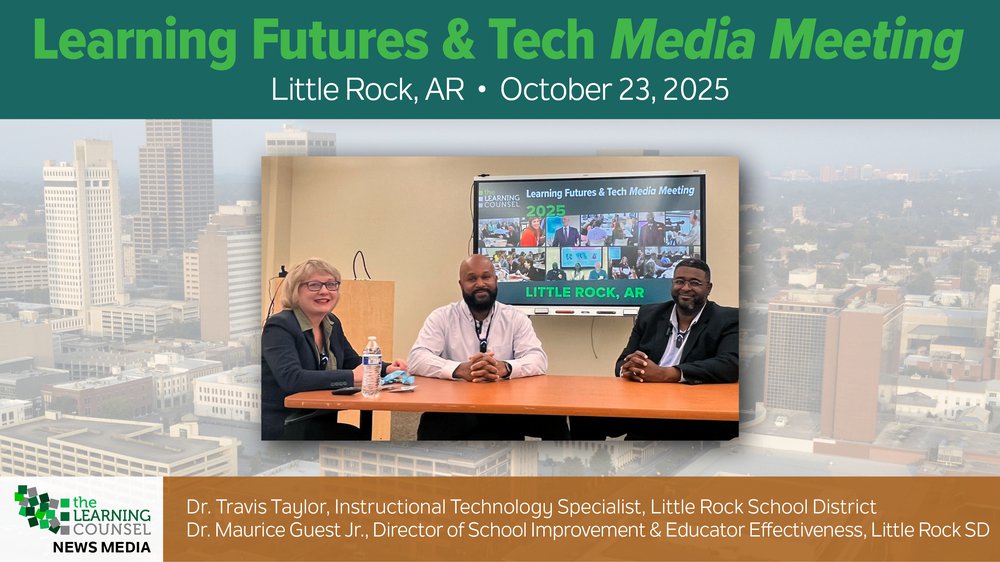
At the Learning Counsel Learning Futures & Tech Media Meeting in Little Rock, Arkansas, a thoughtful panel discussion highlighted how sustained improvement in education is driven not by tools alone, but by people working together with purpose. Moderated by LeiLani Cauthen, CEO of Learning Counsel, the panel featured Dr. Travis Taylor, Instructional Technology Specialist, and Dr. Maurice Guest Jr., Director of School Improvement and Educator Effectiveness—both from the Little Rock School District.
Mrs. Cauthen opened the conversation with a familiar but revealing question: “What are you most proud of?” The answers pointed clearly to the heart of the district’s progress—educators committed to growth, collaboration, and continuous improvement.
Teachers Leading the Shift to Deeper Engagement
Dr. Maurice Guest Jr. began by centering his pride on Little Rock’s teachers. Over the past two years, he explained, the district has experienced a significant shift toward more engaging, student-centered instructional practices.
“There’s been a huge shift toward new, engaging, and innovative teaching practices,” Dr. Guest shared, citing strategies such as turn-and-talks, academic laps, quick writes, and structured student discourse. These approaches, he emphasized, are not theoretical—they are showing up consistently in classrooms and truly engaging students in their learning.
This instructional momentum is now extending into the district’s next major focus: high-quality instructional materials (HQIM). Dr. Guest described a growing commitment to using HQIM with fidelity, ensuring that materials are not only adopted but implemented as designed to support rigorous teaching and learning.
“We’re coming a long way with that as well,” he said. “So I’m proud of our teachers—and the principals who have to make sure that all of that work actually happens in the classroom.”
Sustaining Change Through Trusted Relationships
Dr. Travis Taylor’s response echoed the theme of people as the foundation of progress, focusing on the district’s building-level technology specialists and library media specialists.
“The relationship we have with our building technology specialists and library media specialists has been a sustaining feature of all of our technology integrations and support throughout the years,” Dr. Taylor explained.
From the district’s one-to-one initiatives to interactive board integrations, student information system transitions, and ongoing platform changes, this group has consistently served as the backbone of professional learning and on-the-ground support.
“With so many shifts in technology, building capacity is hard,” he acknowledged. “But this group—their experience, their willingness to learn, and their openness to trying new things—has made the work possible.”
Dr. Taylor emphasized that even those who feel less confident with technology continue to show up, ask questions, and engage in professional learning. Regular meetings, collaborative problem-solving, and ongoing development ensure alignment across schools and departments.
“They may have reservations,” he said, “but they try. And that willingness has allowed us to maintain and sustain the work we’re doing across the district.”
Progress Rooted in Trust and Collaboration
As the discussion concluded, a clear picture emerged of how Little Rock School District is navigating instructional and technological change: by investing in people, strengthening relationships, and supporting educators at every level.
Under Mrs. Cauthen’s facilitation, the panel underscored a central truth echoed throughout the Learning Futures & Tech Media Meetings nationwide—lasting transformation happens when educators are empowered, supported, and proud of the work they do every day.
In Little Rock, that pride is evident in classrooms, in collaboration, and in a shared commitment to moving teaching and learning forward together.
Tune in below for the full panel discussion.