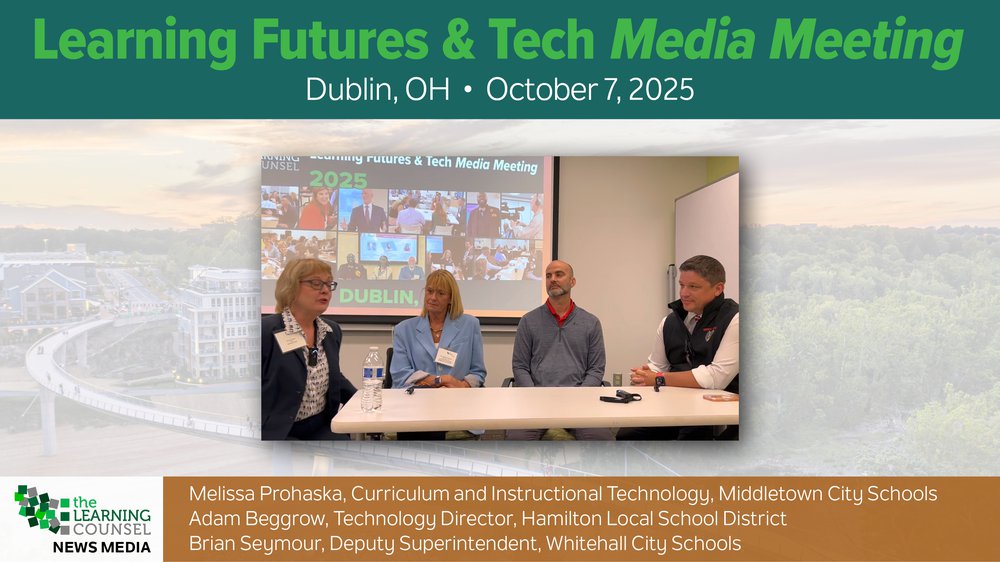
At the Learning Counsel’s Learning Futures & Tech Media Meeting held in Dublin, Ohio, CEO LeiLani Cauthen hosted a dynamic panel discussion featuring education leaders from three rapidly evolving districts. The panel included Melissa Prohaska, Curriculum and Instructional Technology, Middletown City Schools; Adam Beggrow, Technology Director, Hamilton Local School District; and Brian Seymour, Deputy Superintendent, Whitehall City Schools.
Cauthen opened the discussion by asking a simple but revealing question: “What are you happy about, and what are you proud of right now?” The panelists’ responses highlighted growth, innovation, and an expanding landscape of opportunities for students across their districts.
Whitehall City Schools: Growth, Momentum, and Culture Shift
Brian Seymour began the conversation by spotlighting the remarkable progress in Whitehall City Schools, a small but rapidly growing urban district of about 3,400 students.
“When I first started four years ago, we were at 3,100 students,” Seymour said. “We’re now at 3,400. We are growing because families are seeing the importance of what we’re doing.”
Seymour shared that the district has climbed from two stars to three and a half stars on the state report card during that same period—an achievement he credits to a cultural transformation.
“We’re offering new opportunities for kids. We’re building the climate and culture to where teachers want to stay,” he added.
Perhaps the most compelling marker of change is staff retention. Four years ago, Whitehall had to replace 130 of its 400 staff members. This past year, that number dropped to just 53 replacements.
“We’re doing some great things and giving kids and teachers great opportunities,” Seymour said. “And people are choosing to stay because of it.”
Hamilton Local School District: Technology Access That Levels the Field
Adam Beggrow noted that Hamilton Local School District shares similar demographics and community characteristics with Whitehall—something he found “funny and fitting” given the day’s panel pairing.
“I would say our school district is almost a mirror of them,” he said. “We’re probably one of the most affordable districts in Franklin County, and that shapes who we are.”
What Beggrow is most proud of, however, centers on student access to technology.
“In my role as technology director, we’re providing technology to students who otherwise wouldn’t have it,” he said. “And we’re providing a good experience. Teachers and students are enjoying what they have.”
Beggrow emphasized that his goal is not only to maintain current access but to prepare the district for what’s coming next—future-ready technology designed to enhance learning at the right time.
“That’s why I’m here,” he said. “So we can provide what’s coming later at the appropriate time.”
Middletown City Schools: Preparing Students for Tomorrow—Starting in Elementary
Melissa Prohaska’s enthusiasm was unmistakable as she described Middletown City Schools’ bold and intentional shift toward career-connected learning through its Passport to Tomorrow initiative.
“We’re in the fourth year of our Passport to Tomorrow initiative,” she said. “Our saying is, You’ve got to see it to be it and Dream today and rise tomorrow.”
Unlike most districts that begin career readiness pathways in high school, Middletown intentionally started with elementary students. Every student in grades K–6 participates in Passport to Tomorrow classes, exploring all six major career fields.
“Students get so excited—especially in elementary,” Prohaska said. “They have fire trucks visit. We bring in speakers. We work with Adopt A Class. We have partnerships with over 100 businesses that come into our schools.”
The model scales upward. Middletown added the program to middle school two years ago and has just begun rolling it into high school after redesigning the entire experience.
Their first major step: a complete overhaul of the high school program of study.
“It used to be that old 55-page booklet,” she explained. “Now it’s organized entirely around career fields and clusters.”
Students can now look up a field—like engineering—and instantly see all related courses offered in the district. It’s intuitive, personalized, and future-centered.
“It’s been a beautiful experience to watch,” Prohaska said. “Students are finding pathways that excite them and help them imagine who they can become.”
A Collective Vision for the Future
Throughout the discussion, moderator LeiLani Cauthen highlighted how each district’s story reflects larger national themes in education: growth amid challenges, intentional culture-building, equitable access to technology, and a pressing need to prepare students for careers that are rapidly evolving.
Together, the panelists painted a picture of districts that refuse to be stagnant. Whether improving learning environments, advancing tech access, or reimagining career exploration starting in kindergarten, each leader showed what it looks like when schools commit to future-ready transformation.
Tune in for the full panel discussion below.