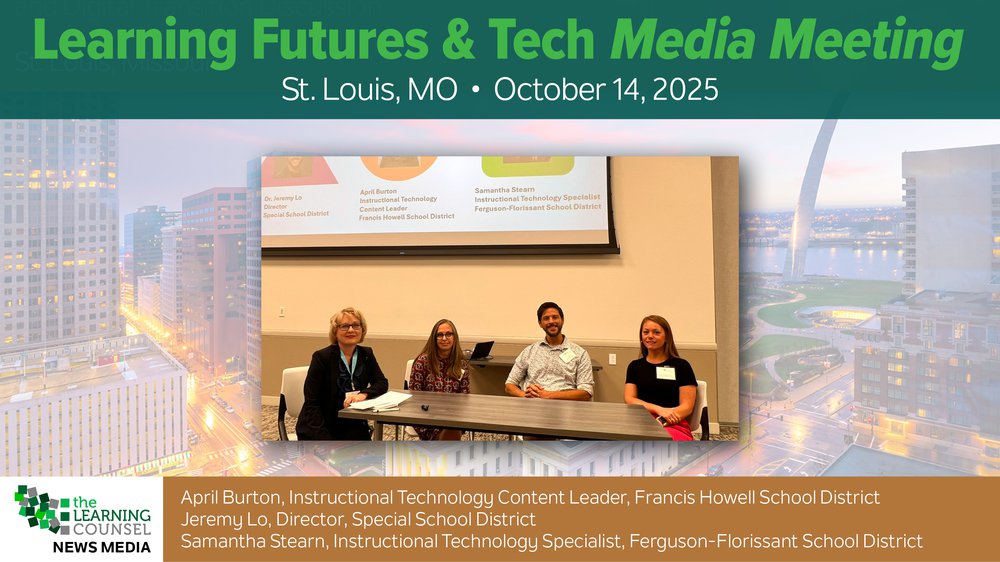
At the Learning Counsel’s Learning Futures & Tech Media Meeting, held at Fort Zumwalt School District in O’Fallon, Missouri, educators came together to discuss the evolving landscape of instructional technology and innovative learning practices. The panel, moderated by LeiLani Cauthen, CEO of Learning Counsel, featured insights from April Burton, Instructional Technology Content Leader, Francis Howell School District; Dr. Jeremy Lo, Director, Special School District; and Samantha Stearn, Instructional Technology Specialist, Ferguson-Florissant School District.
The conversation began with a simple, yet profound question from Cauthen: “What are you most proud of?”
Student-Centered Learning Takes the Spotlight
April Burton highlighted a unique approach within Francis Howell School District: a flexible blended learning environment for select high school students. Unlike traditional blended programs, these students have significant autonomy in shaping their learning paths.
“In our district, students work with their teachers to develop learning plans that best meet their needs,” Burton explained. “They may work outside of the classroom—at home, elsewhere in the building, or even at a coffee shop. This flexible approach empowers them to take ownership of their learning and recognize that they are the central drivers of their educational success.”
Burton, who recently completed her dissertation on this topic, emphasized how this model encourages students to see themselves as active participants rather than passive recipients in the educational process.
STEAM Innovation from Middle to High School
Samantha Stearn shared how Ferguson-Florissant School District has invested in STEAM-focused schools over the past several years. Beginning with a middle school and expanding into a high school, the district emphasizes project-based learning to cultivate creativity, critical thinking, and collaboration.
“Our middle school has been very successful, winning multiple awards,” Stearn noted. “It provides a positive, engaging experience for students and allows them to explore their interests in a hands-on, applied way. The success at the middle school level has created a strong foundation for high school programs.”
AI Integration and Innovation in Special Education
Dr. Jeremy Lo brought a forward-looking perspective from the Special School District, focusing on how technology and AI are being introduced thoughtfully within the district.
“I’m most proud of the space we’ve created to have conversations about AI—what it is, how it applies to us, and how it aligns with our values as a special education district,” Lo said. “We’re exploring concepts like rapid prototyping and successive interventions, ensuring that our students receive the best possible education.”
Lo described how the district is experimenting with AI tools, including GPT-based technologies, to enhance instructional support while maintaining alignment with student needs and ethical considerations. “We are truly exploring what it means to have AI in a public school district,” he added.
Looking Ahead
The O’Fallon panel highlighted the intersection of student empowerment, innovative learning models, and thoughtful integration of technology. From flexible blended learning to award-winning STEAM programs and AI-informed instructional strategies, these districts are reimagining what public education can look like while keeping students and human connection at the center.
As Burton, Stearn, and Lo demonstrated, fostering autonomy, engagement, and ethical innovation provides a roadmap for districts seeking to prepare students for the challenges and opportunities of the 21st century.
Tune in for the full panel discussion below.