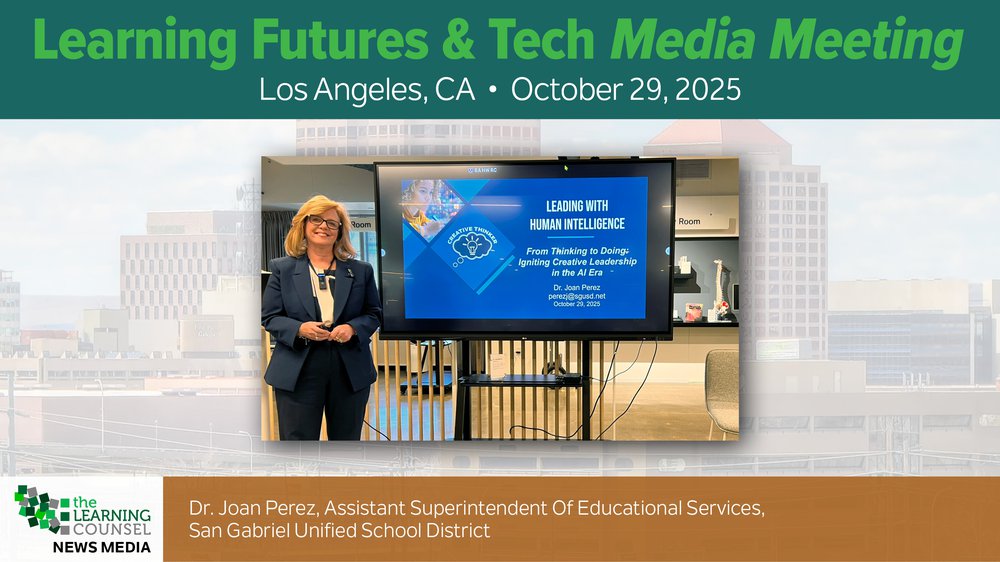
At the Learning Counsel Learning Futures & Tech Media Meeting in Los Angeles, California, Dr. Joan Perez, Assistant Superintendent of Educational Services for San Gabriel Unified School District, shared a compelling look into a two-year journey that has redefined how the district approaches artificial intelligence—not as a replacement for humanity, but as a catalyst for it.
“It’s a pleasure to be here and share a little bit about our journey in San Gabriel,” Dr. Perez began. That journey, she explained, has fundamentally shifted the district’s focus from managing technological change to leading transformational growth centered on what makes us uniquely human.
Starting with Human Intelligence
Early in San Gabriel USD’s exploration of AI, district leaders recognized that the most important question was not what AI can do, but who students need to become in an AI-driven world. “We realized early on that our journey needed to be about the development of what makes us uniquely human,” Dr. Perez said.
Rather than framing AI as a disruptive force, the district chose to “flip the script,” anchoring innovation in human intelligence—the skills that ignite creativity, empathy, critical thinking, and purposeful problem-solving. This shift influenced not only student learning, but also leadership practices, professional learning, and organizational culture.
“Our work has really been about asking: What are the human skills our students will need to set themselves apart in this brave new world?” Dr. Perez explained. “And how do we ignite those same skills in our staff?”
Human-Centered Leadership for Transformational Change
Dr. Perez emphasized that education leaders today are not simply managing change—they are leading transformation. In San Gabriel, this has meant intentionally redefining leadership practices to model the very skills educators hope to cultivate in students.
District leaders have focused on:
- Empowering others and distributing leadership
- Leading with heart, empathy, and trust
- Challenging long-standing assumptions in education
- Creating space and time for creativity, innovation, and risk-taking
“Leadership today requires us to embody the practices we want to see,” she noted. “We must challenge the process, question the thinking that has existed for decades, and give people permission to think outside the box.”
This approach, Dr. Perez explained, creates the conditions necessary for meaningful innovation—especially when navigating rapidly evolving technologies like AI.
From Vision to Practice: The Portrait of a Graduate
San Gabriel USD’s work around human intelligence did not begin with AI. In fact, the foundation was laid in 2019 through a collaborative effort to define the district’s Portrait of a Graduate.
Working alongside an Educational Advisory Committee of approximately 75 stakeholders—including students, parents, teachers, administrators, board members, and community partners—the district identified the human skills and competencies every graduate should possess.
“What made this process powerful,” Dr. Perez shared, “was that student voice and agency were at the center.” Students helped define not only the skills themselves, but how those competencies should develop over time—from transitional kindergarten through grade 12.
The result was a shared vision of human-centered learning that spirals in complexity as students grow, ensuring that these skills are not taught in isolation but deeply embedded throughout the K–12 experience.
Embedding Human Skills into Everyday Learning
Today, San Gabriel USD is working to ensure that human intelligence skills are not treated as an “add-on” or a one-time lesson. Instead, they are intentionally integrated into every subject, every classroom, and every learning experience.
Dr. Perez shared a powerful example from a recent Superintendent’s Student Advisory Council meeting, where a high school senior spoke candidly about the importance of these skills in preparing for life beyond graduation.
“He shared that these skills can’t just be taught at the beginning of the year,” she said. “They need to be woven into every lesson, every subject, throughout the entire K–12 journey.”
District leaders took that message to heart, reinforcing the importance of coherence between vision, instruction, and leadership.
AI as a Tool to Uplift Humanity
As enrollment challenges, digital acceleration, and changing student expectations continue to shape education, Dr. Perez made it clear that San Gabriel USD is not asking how AI will replace human work—but how it can uplift and amplify it.
“We are not thinking about how AI will replace humanity,” she said. “We are thinking about how it will uplift humanity.”
By using AI tools intentionally, the district aims to strengthen creativity, critical thinking, collaboration, and agency—skills that define human intelligence and prepare students for an uncertain future.
A Journey Still Evolving
Now two years into this work, San Gabriel USD’s journey continues to evolve “by the minute,” as Dr. Perez noted. But the district remains grounded in a clear and consistent belief: the future of education must be human-centered, even—and especially—in an AI-driven world.
Through visionary leadership, authentic collaboration, and a deep commitment to student voice, San Gabriel USD offers a powerful example of how districts can lead transformation while keeping humanity at the heart of innovation.
Watch Dr. Perez's full presentation below.