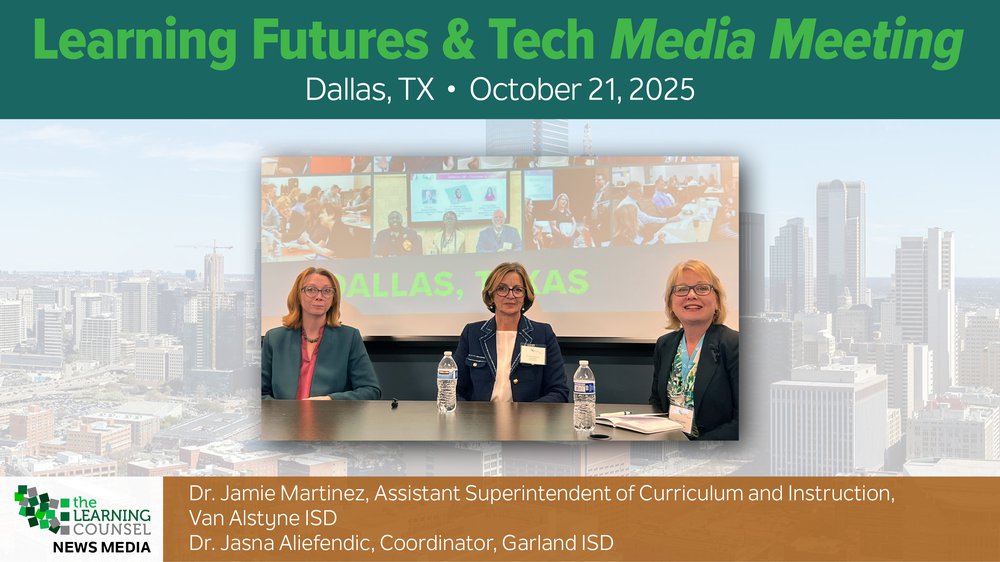
At the Learning Counsel Learning Futures & Tech Media Meeting in Richardson, Texas, a panel moderated by LeiLani Cauthen, CEO of Learning Counsel, explored what it truly means to lead during a time of rapid technological change. Panelists Dr. Jamie Martinez, Assistant Superintendent of Curriculum and Instruction at Van Alstyne ISD, and Dr. Jasna Aliefendic, Coordinator at Garland ISD, offered candid reflections on resilience, innovation, and the courage required to move education forward in the age of artificial intelligence.
Mrs. Cauthen opened the conversation with a simple but powerful question: “What are you most proud of?”
Moving Beyond Fear: Teaching Students to Be Creators, Not Consumers
Dr. Jasna Aliefendic began by addressing the elephant in the room: fear. “Thinking about AI and everything that's happening globally—not just in education—the fear of the unknown is the worst for all of us,” she said.
That fear, she noted, often manifests in familiar refrains about cheating. “If I have to one more time explain the cheating because of AI, I will get a heart attack,” she joked, drawing laughter and recognition from the audience. This anxiety, she explained, is a major reason many educators and administrators initially resist AI initiatives.
Yet in Garland ISD, Dr. Aliefendic said, visionary leadership has helped shift the narrative. “I’m very proud to say that in my district we have some leaders who are very innovative, very encouraging, and absolutely amazing.”
One of the district’s most significant accomplishments has been the creation of an AI course offered as part of Career and Technical Education (CTE). Embedded within multiple programs of study, the course is designed to teach students how AI works—and how to create with it.
“Our students are learning how to be creators, not just consumers of AI,” she emphasized.
Developing the course was not easy. Misconceptions were widespread, with fears that students would be “learning how to cheat.” Dr. Aliefendic pushed back on that thinking with a powerful analogy: “Cybersecurity kids are not learning how to hack the system. They’re learning how to protect the network. It’s the same thing with AI.”
Now in its second year, the AI course is expanding rapidly—from one campus and one section to two campuses and multiple sections. “That’s what I’m proud of,” she said. “We’re giving students the opportunity to understand what AI is and what can be done with it.”
Resilience as a Defining Strength of Educators
Dr. Jamie Martinez echoed the theme of pride—shifting the focus from programs to people. Representing Van Alstyne ISD, a smaller but rapidly growing district, she shared how expansion has been constant: a new high school opened last year, a new elementary school is set to open this fall, and more schools are already in development.
But growth alone was not what she emphasized.
“My team and I began this school year with a shared gratitude journal,” Dr. Martinez explained. “One of the entries last week talked about the resilience of educators—and that is what I am most proud of in my district.”
She described the courage it takes to work in education today. “You have to be brave to be in this system,” she said. “We get beat up a lot. And that’s okay—because I don’t know a single educator who doesn’t wake up every day thinking, ‘I’m going to go work with kids today.’”
Meeting AI Head-On with Policies, Practices, and Curiosity
Dr. Martinez acknowledged that the AI journey has not been easy. Concerns about cheating surfaced quickly, particularly at the high school level. “Last year my teachers were calling me saying, ‘I think they’re cheating with AI. What do I do?’ And I was like, ‘Here we go.’”
Rather than reacting with fear, the district responded with intention. Over the summer, Van Alstyne ISD developed policies, practices, and professional learning focused on AI—both for educators’ own work and for classroom use.
The response exceeded expectations. “My only training room holds 28 people,” Dr. Martinez shared. “We stuffed 47 in there.”
Educators weren’t just compliant—they were curious. “They were excited to learn,” she said. “They wanted to see what was available to make their lives easier and help their kids embrace what’s coming.”
And in a moment of honesty that resonated deeply, she added: “I told them, the kids can already do this better than you can—so we’re going to try to catch you up.”
Leading Forward Together
As the panel wrapped, a common thread emerged: progress doesn’t come from avoiding discomfort, but from leaning into it together. Whether through innovative CTE courses or packed professional learning sessions, both districts demonstrated what’s possible when fear is replaced with trust, curiosity, and purpose.
Under Mrs. Cauthen’s thoughtful moderation, the conversation highlighted a powerful truth: in a time of unprecedented change, the resilience of educators and the courage to reimagine learning remain education’s greatest strengths.
Watch the full panel discussion below.