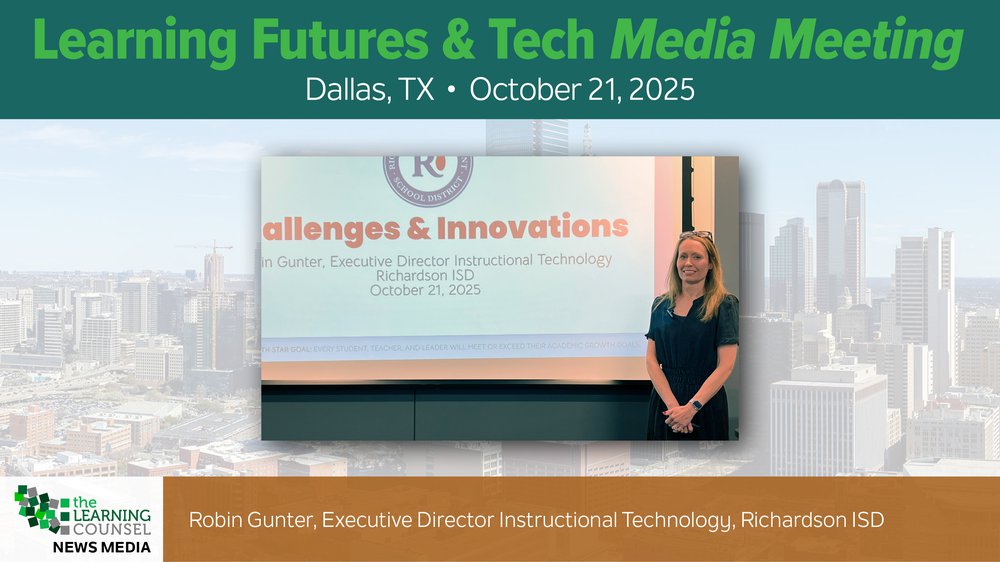
At the Learning Counsel Learning Futures & Tech Media Meeting in Richardson, Texas, Robin Gunter, Executive Director of Instructional Technology for Richardson ISD, offered a refreshingly candid perspective on innovation—one rooted not in hype, but in honest reflection, process, and steady progress.
Opening her presentation, Gunter set clear expectations. While much of the national conversation centers on cutting-edge innovation, she acknowledged that Richardson ISD is still navigating foundational work.
“I’ll be really honest with you,” she said. “Mine are more down here. We’re still working to get up here.”
That transparency framed a session that resonated deeply with district leaders facing similar realities across the country.
A District Defined by Complexity—and Commitment
Gunter began by grounding her remarks in the context of Richardson ISD. The district serves approximately 36,000 students across 50 schools, spanning three cities—Richardson, Garland, and Dallas. Like many districts nationwide, Richardson ISD is navigating declining enrollment, including the consolidation and closure of four elementary schools over the past two years.
This geographic and demographic complexity brings both challenges and opportunities, shaping how instructional technology work unfolds.
Her personal connection to the district runs just as deep. With 28 years in education—all in Richardson ISD—Gunter has served as a teacher, librarian, central services leader, and technology administrator. For the past 13 years, she has worked in instructional technology, reporting to the district’s CTO.
“There’s not a perfect learning management system,” she noted, “and I’m not sure there’s a perfect structure for instructional technology either.”
In Richardson ISD, instructional technology lives within the broader technology department, closely partnering with operations, infrastructure, and teaching and learning to maintain strong instructional alignment.
Reframing Innovation: Progress Over Perfection
Before diving into district examples, Gunter invited attendees into a moment of reflection—asking them to write down one innovation and one challenge from their own work. The exercise underscored a central theme of her presentation: innovation looks different depending on the perspective.
Admitting that the word “innovation” itself can feel intimidating, Gunter shared her initial discomfort with the prompt.
“To me, innovation feels like something really big—bleeding edge,” she said. “And we’ve had a lot of bleeding-edge conversations.”
To reset her thinking, she turned—half-jokingly—to her “trusted friend, Copilot,” which helped her redefine innovation as new or improved tools, systems, or processes that create meaningful advancement.
“That helped me realize,” she said, “we’re probably doing more than we give ourselves credit for—especially with processes.”
Artificial Intelligence: The Innovation and the Challenge
Unsurprisingly, artificial intelligence emerged as the first and most significant topic.
“Brace yourself,” Gunter joked. “Artificial intelligence.”
Rather than reacting hastily to AI’s emergence, Richardson ISD took a measured and intentional approach. Two years ago, the district formed an AI Advisory Board composed of both central office and campus staff. The committee’s purpose was not only to explore AI tools, but to determine how AI aligned with existing district values and practices.
One of the district’s most notable—and at the time, innovative—decisions was not to create standalone AI policies.
“We weren’t going to write AI-specific guidelines,” Gunter explained. “We were going to wrap AI into what we already had.”
Instead, the district updated existing responsible use guidelines and student handbooks, simply naming AI as a tool alongside others. This approach positioned AI not as something separate or alarming, but as part of the evolving digital ecosystem students and teachers already navigate.
The advisory board also played a key role in piloting student-facing AI tools, evaluating their instructional value before broader adoption—a process several attendees recognized from district rotations earlier in the day.
Innovation as Steady, Thoughtful Work
Throughout her presentation, Gunter returned to a consistent message: innovation does not require spectacle. In Richardson ISD, innovation shows up in process refinement, cross-department collaboration, and intentional decision-making—especially in moments when fear or uncertainty could easily drive reactionary choices.
“I don’t think any of this is going to surprise you,” she said. “And that’s okay.”
By normalizing challenges and redefining innovation as progress—not perfection—Gunter offered a model of leadership grounded in realism, humility, and trust.
As the session closed with shared reflections from attendees, her message lingered: in an era of rapid technological change, meaningful innovation often begins with clarity, alignment, and the courage to move forward thoughtfully—even when you’re not yet at the finish line.
Tune in below for the full presentation.