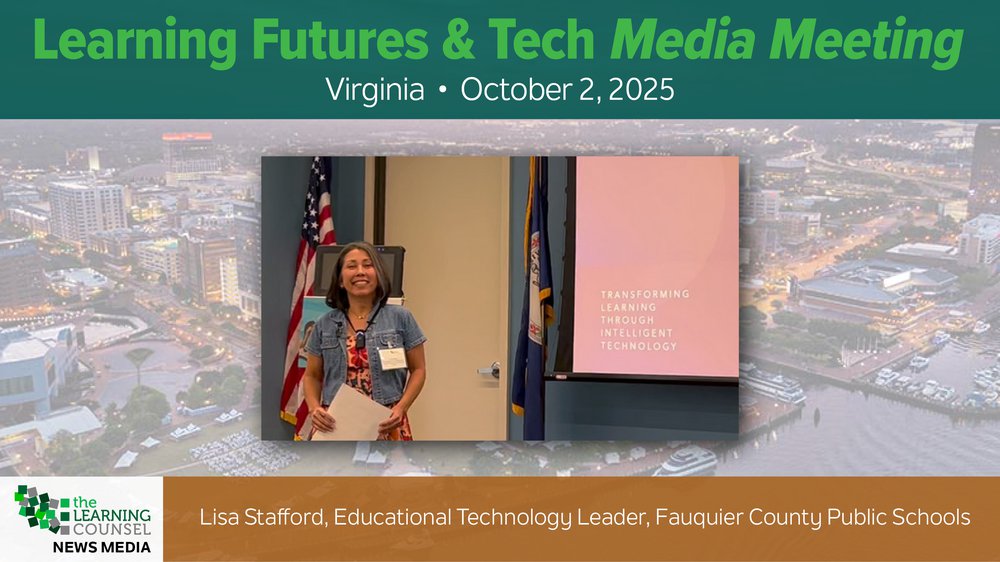
At the Learning Counsel’s Learning Futures & Tech Media Meeting in Warrenton, Virginia, Lisa Stafford, Educational Technology Leader for Fauquier County Public Schools, delivered a vivid and engaging presentation on one of the most pressing topics in modern education: the rise of generative AI and how districts can take control rather than be swept away.
With humor, candor, and a cowboy-themed metaphor that resonated with the audience, Stafford described the moment generative AI burst into the education world.
“It felt like wild horses stampeding,” she said, gesturing toward an image of horses thundering across a plain. That chaos captured both the urgency and uncertainty that educators felt when ChatGPT and other generative tools first arrived.
The Good, the Bad, and the Unknown
Stafford shared that when AI first entered the educational scene, reactions were anything but uniform.
The Worried and Weary
A large group of educators responded with fear and hesitation:
- What data is this tool using?
- Will AI replace my role?
- Will this encourage shortcuts and cheating?
- What happens to accountability for learning?
These concerns were not only common—they were justified. Teachers worried about misuse, ethics, and their changing place in the instructional landscape.
The Eager Enthusiasts
But there was another group—those who welcomed AI with excitement, sometimes bordering on over-enthusiasm.
They saw:
- faster workflows
- new creative possibilities
- improved accessibility
- easier differentiation for students
In their eagerness, however, some were quick to overlook AI’s limitations, biases, and risks.
The Race to Keep Up
All the while, AI platforms continued to evolve at breakneck speed. New tools emerged almost weekly. The pressure mounted for district leaders to determine:
- What does responsible use look like?
- What guardrails are needed?
- How do we help staff strike the right balance between caution and innovation?
“The real task,” Stafford said, “was finding equilibrium between fear and enthusiasm, and empowering educators to use AI intentionally, ethically, and effectively.”
Pulling Back the Curtain: Demystifying AI
Stafford explained that the district’s overarching goal became clear: demystify AI.
Educators needed transparency—not hype. They needed to understand:
- the strengths of AI
- the weaknesses
- the ethical considerations
- and the practical classroom implications
By lifting the veil, the district could reduce uncertainty and help staff develop confidence and judgment instead of relying on assumptions or misinformation.
Preparing for the Showdown: Forming the Posse
With a grin, Stafford revealed the district’s first major step:
“We formed a posse.”
This “posse” became Fauquier County’s AI Committee, a small but highly engaged group of Instructional Technology Resource Teachers (ITRTs) tasked with facing the challenge head-on.
Within this committee, they asked essential questions:
- How do we ease teacher fears?
- How do we promote responsible use?
- How do we support educators who want to run fast without overlooking risk?
- Can we reduce cheating and plagiarism while still adopting these tools?
- What policy updates are needed?
The committee served as both a think tank and a guide, blending research, instructional expertise, and boots-on-the-ground feedback from schools.
Balancing Act: Responsibility Meets Innovation
Stafford emphasized that their work wasn’t about pumping the brakes or stomping on the gas—it was about finding the reins.
Rather than allowing AI to disrupt teaching and learning haphazardly, the district focused on:
- providing structured training
- encouraging ethical and purposeful use
- acknowledging both the benefits and the risks
- and preparing educators for a future where AI would be a constant presence, not a passing trend
In the end, the approach was not fear-based or hype-driven, but grounded in understanding, preparation, and collaborative leadership.
A Future of Intentional Innovation
As Stafford concluded, she reminded attendees that AI isn’t going away. The challenge isn’t to stop the stampede—it’s to learn to ride.
Fauquier County’s work demonstrates that with open dialogue, thoughtful planning, and a willingness to address both excitement and anxiety, districts can transform AI from a runaway force into a powerful ally for teaching and learning.
And with a well-equipped “posse,” they can face whatever the future of generative AI brings.
Tune in for the full presentation below.