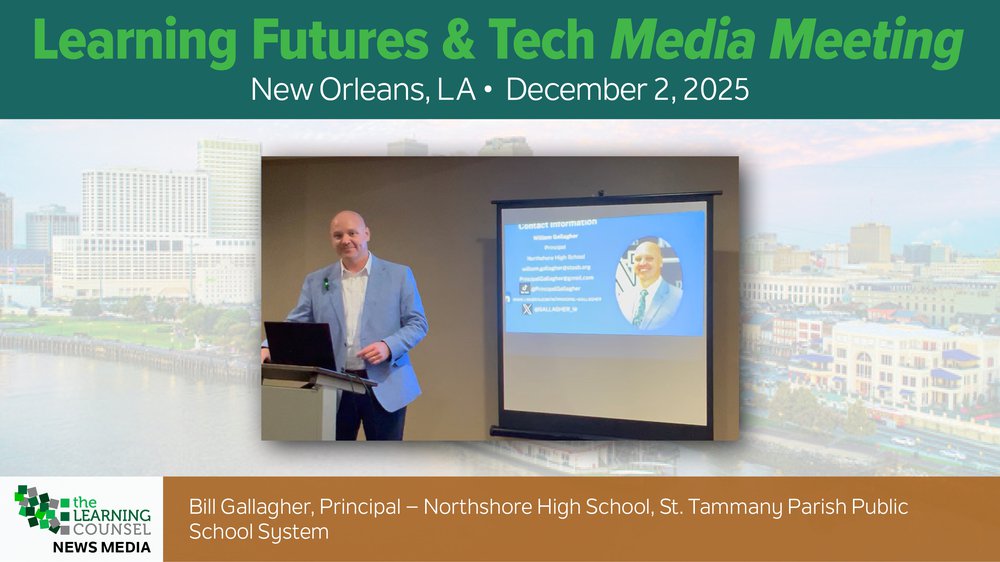
At the Learning Counsel Learning Futures & Tech Media Meeting in New Orleans, Bill Gallagher, Principal of Northshore High School in the St. Tammany Parish Public School System, offered a candid and insightful look at leadership, communication, and the realities of technology use in modern school communities. With 1,600 students and 165 employees on campus, Gallagher framed communication not as a static skill, but as a continuous cycle of learning, reflection, and adaptation.
The Professional Learning Cycle as a Leadership Framework
Gallagher opened his presentation by describing what he called the professional learning cycle, a continuous process that extends beyond classrooms and into every aspect of leadership and organizational growth.
“There’s no starting and stopping point necessarily along this cycle,” he explained. “You’re planning, you’re acting, you’re observing and reflecting, and then you’re planning again.”
This cycle, Gallagher said, mirrors how educators and leaders learn to teach effectively, communicate clearly, and refine their practice. Rather than viewing professional development as episodic, he emphasized the importance of ongoing reflection and iteration as a core leadership practice.
Communication in a Complex School Ecosystem
As a high school principal, Gallagher described communication as one of the most critical—and complex—responsibilities of his role. With hundreds of staff members and thousands of students, effective communication requires multiple approaches and channels.
While communication experts often identify numerous communication styles and strategies, Gallagher distilled them into five core types, all of which intersect with technology-driven communication.
“I’m not a communication major,” he joked. “I’m the principal of a high school—so that does make me a communication expert.”
His point was clear: school leaders must be adaptable communicators, fluent in multiple modalities, and responsive to diverse audiences.
The Digital Reality: It’s Not Just Students
A central theme of Gallagher’s talk was the pervasiveness of digital communication and social media across entire school communities. He challenged the common narrative that only students are overly connected to their devices.
“We like to stand on a pedestal sometimes and say, ‘The students can’t pull away from their phones,’” he said. “But we can’t either. It’s the entire community.”
Gallagher emphasized that digital communication is not a student issue—it is a societal reality that includes educators, administrators, parents, and the broader community. Social media platforms and digital tools now shape how schools communicate, share information, and build relationships.
Understanding Social Media Usage Trends
Gallagher shared data tracking social media usage among teens from 2019 through 2024, highlighting the rapid expansion of platforms and the increasing time spent online. While specific platforms continue to evolve, the trend is clear: students and adults alike are embedded in digital ecosystems.
He noted that by age 10, approximately 40 percent of students already have access to or know how to use a cell phone, underscoring the need for schools to proactively address digital citizenship, communication norms, and responsible technology use.
Implications for School Leaders
Gallagher’s message carried important implications for educators and school leaders. Effective communication in the digital age requires more than sending messages—it requires intentional strategy, continuous learning, and self-awareness.
By embracing the professional learning cycle, leaders can refine how they communicate, evaluate the impact of their messaging, and adapt to the evolving digital landscape. Schools must also recognize that technology-driven communication is not a passing trend but a permanent feature of modern education.
Leading Through Reflection and Adaptation
Gallagher concluded by reinforcing the importance of reflection in leadership practice. The professional learning cycle—plan, act, observe, reflect, and repeat—provides a framework for continuous improvement not only in instruction, but also in communication and leadership.
In a world where digital communication shapes every interaction, Gallagher’s insights offered a reminder that effective leadership is iterative, responsive, and deeply connected to how people communicate. For school leaders navigating an increasingly connected environment, the professional learning cycle may be one of the most powerful tools for growth and impact.
Tune in below to see the full presentation.