
The nation’s second‑largest school district is bracing for a system‑wide shutdown on April 14, after United Teachers Los Angeles (UTLA) and two other major unions announced they will strike if no contract deal is reached. The unions are demanding wage increases of roughly 17% over two years, protections against subcontracting and AI replacing educator roles, more mental health and special education staff, and class‑size reductions — while Los Angeles Unified School District (LAUSD) counters with an 8% raise and warns of long‑term fiscal strain. [abc7.com], [abc7.com]
The strike threat lands amid heightened scrutiny over district spending. UTLA has publicly questioned how over $1 billion in current‑year education funds “vanished” into outsourcing, edtech contracts, and central‑office reallocations, according to its own financial analysis and bargaining materials. [abc7.com]
This tension erupted just as edtech’s largest convenings — from FETC to TCEA — reflected a sharp shift in mood. Vendors reported lower booth engagement, with educators approaching products not with curiosity, but with skepticism, stricter critical evaluation, and deeper questions about architectural fit. Many asked not “What does it do?” but “Where does this fit within our system‑wide transformation — or does it fit at all?”
A complicated question since the edtech sprawl in most schools is vast, and most teachers and administrators really have no real idea how much of a sprawl. Some of the Tech Directors do, but the question of edtech has largely been one of what the academics want with the techies facilitating. Learning Counsel Research estimates total 2026 spend by both districts and individual schools (public) is $38.67 Billlion, covering some 40.25M students with spend in large districts estimated at $1,033 per student total.
On Friday the 27th, ASU+GSV’s 2026 Summit, a global hub for education investors and innovators, entered this climate on the defensive. After hearing that some union leaders were privately advising educators to avoid the conference and decline speaking there, its co‑founder issued a national reassurance email to participants, affirming the Summit’s mission to “advance the cause of innovation” and challenging critics to acknowledge that “the status quo is failing the majority of children and adults in America today.” [utla.net]
That status quo is indeed under historic pressure. Direct Union attacks on edtech and the investment class. Teacher strikes incoming. Budget woes on all sides. Mass attrition of students to alternatives of all kinds. Disarray, dismay, with hundreds if not thousands of schools under-enrolled and on the chopping block.
Earlier Signs of Strain
A 2024 Learning Counsel Research study showed the structural load on schools has reached a breaking point:
- 87% of teachers report being overwhelmed by expectations
- 41% of administrators seek to move beyond the whole‑group, industrial‑pattern model
Meanwhile, PowerSchool’s 2025 report underscored how instructional design itself is losing viability:
- 36% of educators say “one teacher, many students” is no longer workable
- Only 29% feel able to personalize learning effectively
The exhaustion is not due to teacher resistance — it is due to the collapse of a model that has maximized the teacher’s burden for decades while point solutions or systems-that-merely-automate-the-old-structure continue to pour out from the edtech industry. While much of the new edtech is fantastic, it is also making the overall burden worse, until finally…the arrival of AI, and a leap by teachers from feeling overwhelmed to downright ready-to-quit. If it were true that AI could replace teachers, this might be a great thing for edtech to just go along with, but it’s not true. It will never be true that young humans learn best by, and only by, machines. The physics law of affinity cannot be beat. Our minds address both the physical world and our fellow humans.
By lack of vision to change structure, the actual organizational charts and how learning is delivered in space and time, now everyone suffers. In the business world, Amazon and Uber just built alternate structures and in a few short years have nearly wiped out the original versions of retail and taxis. Schools have had the opportunity to “rethink” themselves for decades but have never gone past the alteration of internal existing mechanisms. Tinkerers with programs and staffing and budget trimming.
Decline, Displacement, and Disaggregation
Learning Counsel’s national projections for 2025–2030 show accelerating shifts:
- Public schools: 45.2M → 28.5M students
- School closures: up to 10,000 cumulative
- Microschools/pods: doubling to 3M
- Homeschooling: 4.2M → 6M
- Teacher shortage: stabilizing at a ~25% gap by 2030
Simultaneously, Learning Counsel’s “gravitational pull” analysis ranks decentralization momentum at 7.5/10 — driven by long‑-term shifts in work, family structure, tech ownership, safety perceptions, and cultural trust. More than 78 indicators suggest centralized district dominance will fall below 35% likelihood by 2040, while decentralization outcomes exceed 65–70%.
Schooling is not drifting — it is being pulled apart faster than it can rebuild.
Misconception: The Future Is Teacherless. Reality: The Future Is Teacher‑Lifted.
Into this turbulence has stepped another misconception: that AI means teacherless classrooms.
It does not. There are already two new types of schools on the landscape and only one is largely teacherless -- the AI-does-the-teaching model is only one of them.
The other creates dramatic teacher efficiency by using a different type of AI that uses time as it’s major substrate. Since schools run on time and intersection of humans, the hardest part is getting every need managed so that every student reaches achievement goals. The problem is that humans are widely different. Running them in a manufacturing pattern of hour-by-hour subjects toward a finish line that everyone must cross together at the same time is not realistic and may have always been the wrong structure. Moving to dynamic live teaching, every student truly moving at their own pace at any level, and additionally elevating teachers to less of the grading, discipline and mundane work is a game changer.
AI handling the clerical and logistical load is what is truly necessary. AI being another tool to learn to be “literate” about is a distraction.
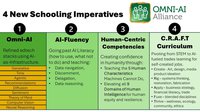
The New Horizon: Six Pillars Will Define Schooling
As districts face walkouts, layoffs, budget cliffs, enrollment drops, and rising public scrutiny, the question is no longer whether schooling will change — but what it will become. Leaders who aren’t curious about this are, quite frankly, insufferable.
What do all the trends point to?
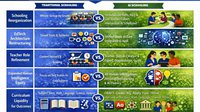
1. Schooling Reorganization
Whole‑group, fixed‑pace learning will give way to pace‑based, AI‑coordinated cohorting, with teachers intersecting students at precisely the right instructional moment. Time AI’s orchestration layer enables:
- dynamic cohorts
- mastery‑aligned pacing
- flexible “lesson‑point” instruction
- on‑demand teacher intervention
This is not personalized learning software — it is a new operating system for schooling.
2. A Unified Edtech Architecture
The teacher‑centric tool era — dozens of apps, dashboards, silos, and manual workflows — is ending. The next decade shifts to:
- omni‑AI infrastructure controlling scheduling, delivery, pacing, assessment, cohorting, enrollment, and reporting
- interoperability across all learning objects
- integrated ecosystem, not fragmented tools
The architecture becomes systemic, not app‑based.
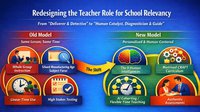
3. Teacher Role Refinement
Teachers move out of impossible multitasking roles (content delivery, clerical work, discipline, differentiation, grading) and into:
- catalyst
- diagnostician
- expert
- relational guide
The highest human faculties — expertise, insight, connection — become the center of teaching again. In a reorganized system of teaching and learning there are still all teaching methods, including lecture, Socratic discussion, and more. Just on repeat, shorter, for smaller groups who are all at exactly the same point.
4. Human Intelligence Equity
For more than a century, American schooling — including its testing, accountability systems, and curriculum structures — has defined “intelligence” almost exclusively through two channels: linguistic and logical‑mathematical. This made sense in the industrial era, when literacy and computation fed into office work, clerical systems, engineering, and the professions. The original Gardner framework similarly assumed that schooling’s role was to map intelligence to cultural and academic expression.
But in the Age of AI, this narrow definition is no longer tenable.
AI systems now outstrip humans precisely in the two domains schools over‑value: pattern recognition, computation, procedural logic, and language generation. Meanwhile, the other seven human intelligences — the ones that drive creativity, ethics, perception, mobility, formation, and meaning — are the very domains AI cannot replicate. [utla.net]
The result is a deep structural inequity.
For over a century, American education has measured only two intelligences and ignored seven, meaning no student population — across any racial, socioeconomic, or geographic group — has ever had equal opportunity to fully develop all nine human intelligence domains.
This means something profoundly important:
We do not actually know what the true distribution of human talent looks like.
Not because of innate differences, but because the system has never cultivated or measured the full spectrum of human cognitive architecture. Suppressed intelligences create suppressed futures — and as families, microschools, policymakers, and curriculum providers begin breaking from the old model, an entirely new horizon is opening.
The essential question becomes: What industries emerge when all nine intelligences finally develop? Industries grounded in creativity, ethics, motion, formation, meaning, ecology, and fusion — fields AI can assist but never replace. For families, this question is already at the forefront out of concern for their children.
The Learning Counsel’s revised framework defines nine intelligences mapped to the primary channels through which humans think and act:
- Intrapersonal
- Interpersonal
- Linguistic
- Logical (Mathematical)
- Naturalistic
- Formational
- Incorporeal
- Motional
- Ethical
Full article here: https://thelearningcounsel.com/articles/the-new-education-imperative-the-9-human-intelligences-revised-for-the-age-of-ai/, Whitepaper for download here: https://thelearningcounsel.com/papers/the-new-education-imperative-the-9-human-intelligences-revised-for-the-age-of-ai/
These are not academic “subjects.” They are the operating system of human cognition — how humans evaluate matter, life, space, energy, time, communities, and the self. Ethical intelligence, defined as the governor that adjudicates decisions across all others, becomes especially critical as non‑living AI systems increasingly influence human decision-making at scale. [utla.net]
This matters now because the economic ground is shifting beneath us.
As AI absorbs tasks once reserved for educated professionals — writing, coding, analyzing, optimizing, clerical work — the market value of linguistic and logical performance is declining. What rises instead are the intelligences machines cannot automate: creativity, ethics, formation, motion, spatial reasoning, interpersonal navigation, and hands‑on craftsmanship. If they do not rise, AI eventually reaches dwindling returns and a tipping point for all governance occurs. The only real tipping point is no avenues to create, an end of the game of life.
Future industries — many not yet born — will be built on these domains. Entire sectors will arise around what humans uniquely do: imagine, shape, fuse, negotiate, lead, craft, innovate, and ethically govern machine systems.
Human Intelligence Equity therefore means the full development of all nine intelligences, not as soft supplements but as economic imperatives. It reframes the purpose of schooling from:
- scoring → capability development
- compliance → cognitive diversity
- narrow aptitude → human flourishing in an AI economy
It also links directly to CRAFT, the next point — and to the broader transformation already underway — positioning humans not as AI’s rivals but as co‑intelligent agents shaping the next civilization.
1. CRAFT: The Next‑Era Learning Design
The next horizon of learning will not extend the STEM‑era story — a narrative built for an economy that no longer exists. CRAFT emerges as a response to modern workforce conditions and family expectations for self‑directed economic futures.
Recent national shifts make this unmistakable:
- Over 50% of STEM graduates are underemployed or working outside their field; 8% remain unemployed.
- 78% of adults see a rising interest in trade careers among youth.
- 50% of Gen Z plans to enter a trade.
- 60% of teens prefer starting their own business over taking a traditional job.
- 93% of Gen Z graduates and 80% of parents believe trades offer better economic security than college.
- 85% of parents support equal or greater funding for skilled‑trade education than for four‑year degrees.
Families are redefining success:
not college acceptance, not test scores, not attendance — but economic agency and meaningful livelihood.
CRAFT meets this demand — and in the Age of AI, it is underpinned by AI.
Where STEM positioned humans as cogs in the tech economy, CRAFT positions them as creators, builders, solvers, synthesizers, and self‑authored economic participants.
C — Create
Generative making, design fluency, artistic expression, inventive capacity.
Students unlock originality — the one human capacity AI cannot imitate.
R — Rig
Building, engineering, fabricating, modeling, repairing — across physical and digital systems.
As automation expands, these become high‑security upward‑mobility roles.
A — Apply
Real-world problem solving, entrepreneurial action, contextual learning.
Students move from “knowing” to executing.
F — Fuse
Cross-disciplinary synthesis and human‑AI integration.
Students learn to merge subjects, methods, technologies, and intuition.
T — Thrive
Personal agency, adaptability, economic resilience, and the ability to create one’s own livelihood if the market does not supply one. Thriving replaces testing as the metric.
CRAFT is not a curriculum or pathway. It is a logic of learning calibrated for a world where AI handles the repetitive and procedural, and humans must excel in originality, dexterity, judgment, synthesis, and resilience.
Why CRAFT Now?
Because families are demanding something fundamentally different from schooling:
- not better attendance
- not slightly higher math/ELA scores
- not college‑prep paperwork
- not compliance with 20th‑century metrics
Those are government’s requirements and structure, a government currently possessing the lowest trust by the American people ever. Families don’t care about what government wants anymore.
They. Don’t. Care.
They want their children to possess the confidence, competence, and creative power to build their own futures — to construct work, build enterprises, design solutions, or enter skilled trades offering real security.
CRAFT allows schools to finally say: “We can develop a young person who doesn’t just get a job — but who can make one.”
This is a radically different promise than the industrial school era ever envisioned — and it is exactly the promise demanded in the post‑strike, post‑standardization landscape.
A Horizon Emerging from Crisis
UTLA’s April 14 strike threat is not merely a labor dispute — it is a symptom of a system that has reached the limits of its industrial structure. The vanished funds, the rising skepticism at edtech conferences, and the defensive posture of national innovation forums all signal that the old model is fracturing. It can’t be fixed with point solutions anymore. Applying AI to it helps with some time saving but ultimately is being wrongly positioned to displace human teaching entirely.
The future is not less tech or teacherless schooling. It is:
- structural reorganization (especially orchestration of Generative/Agentic/Time AI)
- unified AI architectures
- teacher elevation
- human intelligence development expansion
- CRAFT‑aligned learning
Whether districts adapt proactively or are forced to adapt by enrollment loss, strikes, budget cliffs, and public pressure, the shift is already underway.
Knowstory.com is where the future is being built with Time AI for auto-cohorting and a marketplace integrating favored courseware and content, including specialty operation for K-3 learners for paper-based learning.
***