
Forward

A Learning Counsel initiative advancing a new discipline for educational leadership, organizational effectiveness, and AI-era readiness.
Free research, briefings, surveys, audits, indexing, scorecards, and leadership supports for schools and districts.
Why Forward >
For over a decade, Learning Counsel has researched instructional technology, digital transitions, leadership, curriculum, learning systems, and innovation in education.
Today, much of the national conversation has shifted to screen time, artificial intelligence, and emerging technologies.
Important as those subjects are, they increasingly point to a larger challenge:
How should schools and districts be designed for what comes next?
Forward > was created to explore that question and is a discipline.
A discipline aimed at the missing work of dismantling bad burdens and feral frictions that haunt many districts.
From Fragmentation to Orchestration
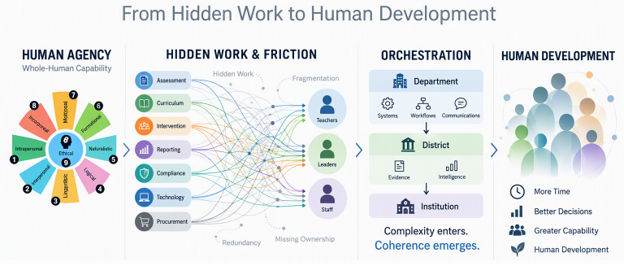
Schools and districts are not short of systems, programs, expertise, or effort. The problem is that these elements often operate beside one another rather than as one coherent organization.
Curriculum, assessment, intervention, special education, multilingual learning, technology, reporting, communication, procurement, scheduling, and compliance each create their own workflows, evidence, decisions, and handoffs. When those parts do not connect, people become the connectors.
Teachers reconcile resources. Specialists rebuild supports. Leaders search for evidence across systems. Departments coordinate through meetings, spreadsheets, email, and individual relationships. Important work continues, but much of the labor required to hold it together remains invisible .
Forward > calls the deliberate coordination of these parts orchestration.
Orchestration means designing how people, time, curriculum, technology, communication, evidence, resources, decisions, and intelligence work together so that:
- work reaches the right owner;
- information moves toward decision and action;
- handoffs do not depend on individual heroics;
- repeated and low-value labor is reduced;
- human judgment remains visible;
- institutional knowledge is retained; and
- more human capacity reaches teaching, leadership, relationships, and development.
Some orchestration is organizational. It comes from clearer ownership, better communication, redesigned workflows, aligned decisions, and improved governance.
Some orchestration is technological. Systems can connect information, preserve context, route work, monitor conditions, and reduce repetitive traffic.
Some orchestration may be supported by artificial intelligence. AI can retrieve, summarize, detect, recommend, coordinate, or execute approved routine actions within defined boundaries.
Forward > is not an AI program. It is the discipline for deciding what should be connected, what should be redesigned, what intelligence can appropriately carry, and what must remain human.
Learn That AI Is Not One Level of Change
The presence of AI does not by itself make an organization coherent. A district may provide individual AI tools while leaving its underlying workflows, ownership, communication, and system fragmentation unchanged.
Forward > distinguishes among four levels of AI deployment:
- Individual AI
People use independent tools to research, create, summarize, or analyze. - Bounded System AI
Intelligence operates inside a specific application, curriculum, or defined workflow. - Cross-System Orchestration
Intelligence helps coordinate related systems, evidence, roles, and actions across a function or department. - Institutional Intelligence
Governed intelligence supports coordination across the organization while preserving human accountability, decision rights, auditability, and judgment.
The higher levels do not simply mean “more AI.” They require stronger organizational clarity, governance, permissions, evidence, communication, and human oversight.
The Forward > question is therefore not, “How much AI does the district have?” It is, “What operating model is the district creating, and does it expand or consume human agency?”
A New Discipline
Human Agency Design is the study and practice of improving the conditions under which people work, lead, teach, and learn.
The discipline examines:
- Organizational effectiveness
- Human capability
- Leadership conditions
- AI orchestration
- Institutional capacity
- Communication structures
- Workflows and decision-making
- Future readiness
Rather than beginning with technology, Human Agency Design begins with people and the systems surrounding them.
The central question is simple:
How can educational organizations increase human effectiveness in a period of accelerating complexity?
______________________________________________________________________
Face-Forward Work
Most educational organizations are occupied with maintaining the present.
Forward > advocates for Face-Forward Work:
The intentional study of changing conditions, emerging technologies, human development needs, organizational structures, communication architectures, and future operating realities before they become sources of friction, confusion, workload, or crisis.
The new guiding question for leaders becomes:
What future are we quietly building with the decisions we are making today?
District Index
A Learning Counsel observational review intended to illuminate organizational conditions across a district.
Developed through public information, observation, interviews, surveys, district interactions, and other available evidence, the District Index examines:
- Organizational coherence
- Human capacity
- Communication architecture
- Human values
- Leadership conditions
- Operational alignment
- Hidden work and friction
- AI Utility mapping
- Orchestration readiness
It is the work of looking beyond immediate issues to understand the organizational realities, opportunities, and risks that may shape the next decade of education.
The purpose is not evaluation.
The purpose is visibility.
The Index helps leadership teams see organizational conditions that often remain difficult to observe from inside the system.
District Indexes may be developed by invitation, collaboration, observation, or as part of Forward > research initiatives.
(Get Sample)
Procurement Methodology Scorecard
A Learning Counsel review of the methodologies used to evaluate, select, and approve curriculum, instructional technology, and educational services.
The scorecard examines whether procurement and adoption processes can recognize:
- Hidden integration burdens
- Teacher assembly work
- Workflow implications
- Human capacity impacts
- Organizational coherence
- Future operating models
Many review processes were designed for an earlier generation of educational products. Forward > examines whether today's methodologies can identify the operational realities created by increasingly digital, connected, and AI-enabled systems.
The objective is educational.
The scorecard is intended to help districts understand how procurement structures influence long-term organizational conditions and future capacity.
(Get Sample)
Issued Reviews
Forward > is beginning to issue District Indexes and Procurement Methodology Scorecards as part of Learning Counsel's ongoing research and field intelligence efforts.
These reviews are intended to advance discussion around organizational effectiveness, human capacity, orchestration, instructional coherence, leadership conditions, and future readiness.
Public findings, issued scorecards, and district reviews will be published here as they become available.
This starts making the page feel like a movement and not merely a website.
Instruments of the Discipline
Forward > develops practical instruments intended to help leaders better understand organizational conditions.
Audit Workbook
An instrument for examining hidden work, fragmentation, ownership, coordination, and operational effectiveness.
The Audit Workbook is a set of documents for digital-fill or paper copying for multiple departments in districts and leadership.
[Download Workbook]
Educational Briefings
- Briefing 1 | Market Briefing - Discover Hidden Capacity
- Briefing 2 | Market Briefing - Designing for Human Development in the Age of AI
- Executive Briefing | Introducing Forward and the Audit Workbook
[REQUEST A BRIEFING - Contact Us)
Underwriters
Founding Underwriter
Kiddom supports the advancement of Human Agency Design, organizational orchestration, instructional capacity, and the future of learning systems.
Contributing Underwriter
KnowStory supports ongoing exploration of Human Agency Design, educational orchestration, Time AI, and future-ready learning systems.
Better Conditions. Better Decisions. Forward Better.
Forward > is a Learning Counsel initiative dedicated to helping education leaders better understand organizational conditions and engage in face-forward work for the age of artificial intelligence.