
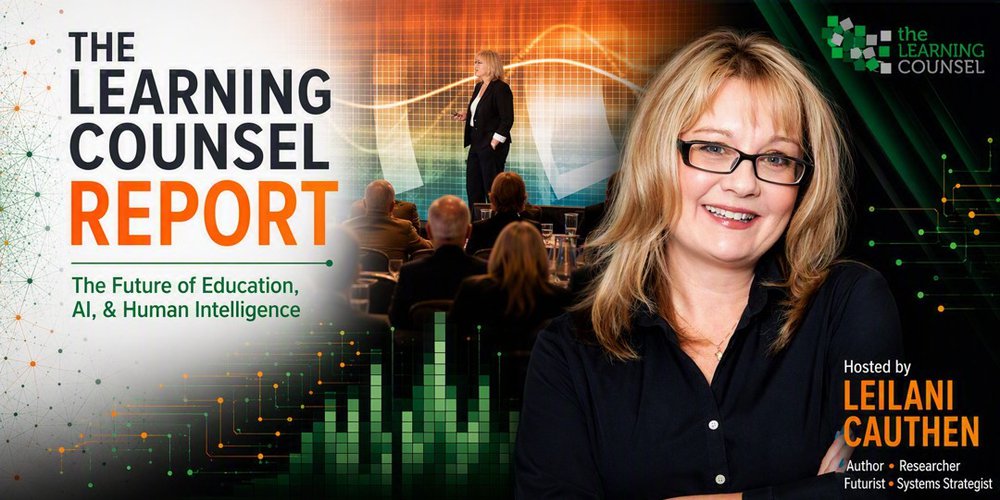
Podcasts with LeiLani Cauthen
Author, Researcher, Futurist Systems Strategist
Education is entering a new era. Artificial intelligence, human capacity, instructional design, policy, curriculum, leadership, and technology are converging to reshape how teaching and learning happen.
What comes next? What are leaders in schools and edtech doing?
What are the uniquely human domains of learning, leadership, creativity, judgment, motivation, culture, and connection? Which aspects of education should remain human-designed, and which should be AI-orchestrated? How are organizations redefining the relationship between human capacity and machine capability, and what new instructional architectures, leadership models, and learning experiences will emerge?
The Learning Counsel Report explores these questions through conversations with education leaders, researchers, innovators, policymakers, practitioners, and technology visionaries shaping the future of learning.
5 Ways to Accelerate Math by Doing
A discussion with Ki Karou about the challenges of teaching today. Karou introduces five areas that the science of learning have identified as key to students’ doing – and how those are aids to accelerating learning, including the awesome capability of helping learners potentially jump through multiple grades to catch up in little time. Listen in to learn about things the neuroscience has uncovered including “self belief,” “schema building,” and more.
Ki Karou is the Senior Director of Product Content at MIND Education, where he leads a team oflearning and game designers, artists and mathematicians. Ki has been designing neuroscience-driven ed tech solutions for over a decade and is widely published and a top speaker in the edtech industry.
Responsible AI and Future AI
LeiLani interviews Justin Jordan, a former educator and Senior Product Manager at Cisco about the definitions of AI, how AI has permutated into many aspects of technology and what we need to be responsible for as we humans brave the new world where AI is in everything. Also find out things about Cisco and AI you might not have known by listening and learning.
How We Should Respond to AI and What's Next
Listen in as LeiLani discusses how we should be responding to AI in education with long-time friend and esteemed colleague in the field, Roland Antoine, Innovative Projects Manager at Dallas ISD in Texas. Roland introduces the idea that the problem is the “problems definition” and that we must proceed to use AI against clearly defined problems, and that AI should be able to act like a GPS of content for students. Both agree AI will not replace teachers but that we are in an age of applying a new wave of creativity in the same way humans applied it in the transition from the farming Agrarian Age to the Industrial Age and into the Technology Age. At each turning point, more horizons opened. Hear what’s next that AI will also bring to education that will also change how space and time is used.

Making the Most of Remaining ESSER Funds
Fear of the “fiscal cliff” and what to spend remaining ESSER funds on is a hot topic in schools. Listen in as Leilani discusses the topic with Jon Hummell, Director of State Initiatives at Lexia Learning. Productive use of the money may not be what you think.
AI and Algebraic Thinking About Time and Space in Schools
Listen in as LeiLani chats with Maurice Draggon, Sr. Director of Digital Learning at Orange County Public Schools in Orlando, Florida. First they discuss the implications of AI in schools and then the emerging time and space AI known as Intelligent Calendaring for its possibilities and then the combination of both new technologies for “uberizing” learning. Along the way, comments about what AI will not do and the human teacher intersecting live with students more efficiently makes for an interesting conversation you don’t want to miss.
Shrinking School IT Teams and 3 Imperatives
Listen in as LeiLani discusses the problems of shrinking school IT teams and three imperatives with Mary Schlegelmilch, who as a former educator has extensive knowledge in distance learning and online learning as a member of the Cisco Education team. Discover how the three imperatives are a “team sport” of administrative, teacher and even bus driver activity.
What is the Science of Reading (Through the Lens of Pedagogy and Teacher Practice)?
Listen in as LeiLani learns a thing or two about the what the science of reading really is from Carey Sweet, National Senior Education Advisor Education Partnerships at Lexia Learning. While reading may be thousands of years old, the science of it has evolved over time. Good literacy instruction has elements and components – and deliberate practice. For certain the wars over reading instruction are getting an infusion of research and new approaches that are worth finding out about.
A Social-Emotional Imperative: Supporting both Dyslexia and Developmental Language Disorders (DLD) through Software Innovation
Every Superintendent in America seems to be identifying their number one issue is the social-emotional wellness of students. Interestingly, aspects of instruction may be the front line of address. Missing ingredients to instruction can exacerbate problems with achievement for students with dyslexia or DLD – inevitably reducing willingness and wellness. Who knew how different and interrelated reading and comprehension issues were for both, and how student agency and exact teaching practices could make a world of difference? Find out in this important discussion with Dr. Suzanne Carreker from Lexia Learning.
Education Technology for Emergent Bilinguals: Overlooked Aspects to Consider When Interpreting the Research
In this episode of the Learning Leadership Society Podcast, your host, Learning Counsel News Media and Research CEO LeiLani Cauthen, talks with Nicholas Feroce, Ph.D., Research Scientist at Lexia Learning about research design in the area of emergent bilinguals, and program causality to effect notable gains among that population.
Cybersecurity in K12
In this episode of the Learning Leadership Society Podcast, your host, Learning Counsel News Media and Research CEO LeiLani Cauthen, talks with Mary Schlegelmilch, Education Advocate at Cisco. They discuss the changes in K-12 education, and how the pandemic changed culture and mindset, and brought cybersecurity in education to another dimension.