
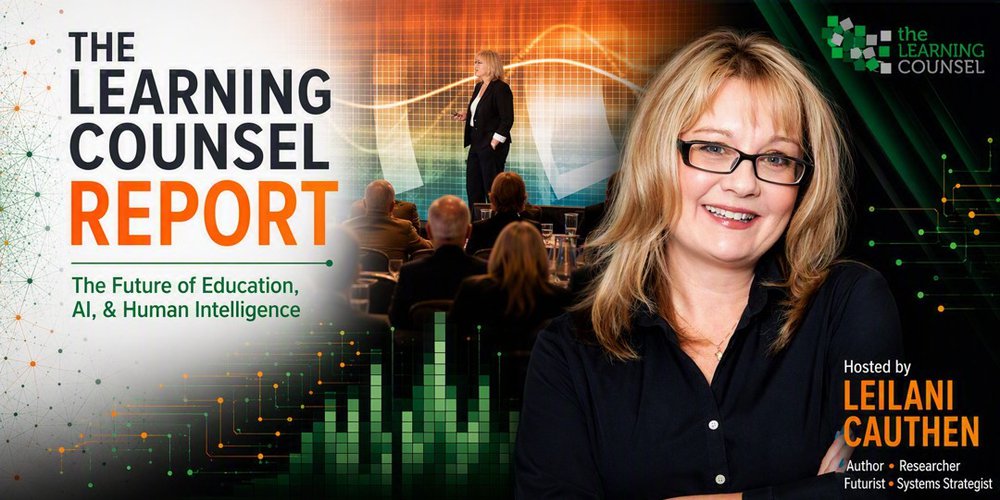
Podcasts with LeiLani Cauthen
Author, Researcher, Futurist Systems Strategist
Education is entering a new era. Artificial intelligence, human capacity, instructional design, policy, curriculum, leadership, and technology are converging to reshape how teaching and learning happen.
What comes next? What are leaders in schools and edtech doing?
What are the uniquely human domains of learning, leadership, creativity, judgment, motivation, culture, and connection? Which aspects of education should remain human-designed, and which should be AI-orchestrated? How are organizations redefining the relationship between human capacity and machine capability, and what new instructional architectures, leadership models, and learning experiences will emerge?
The Learning Counsel Report explores these questions through conversations with education leaders, researchers, innovators, policymakers, practitioners, and technology visionaries shaping the future of learning.
From Pop-Culture to Classrooms: Driving Student Engagement Through Stories
With the release of Supergirl creating a flashpoint in pop culture, this episode explores how Warner Bros. Discovery, DC, and Discovery Education are turning superhero storytelling into powerful learning experiences for students. LeiLani Cauthen speaks with Euan Lampitt, Vice President of Corporate Social Responsibility at Warner Bros. Discovery, about the impact of the DC Superpowered Storytellers initiative and the partnership with Discovery Education. Together, the organizations have reached students through more than 3,200 schools and youth organizations, helping make creative, career-connected learning accessible to all.
Euan shares how iconic superhero characters help students build creativity, confidence, and a sense of purpose while connecting classroom learning to real-world career pathways. The conversation highlights Discovery Education’s role in developing rigorous, standards-aligned English Language Arts (ELA) and cross-curricular curriculum that uses storytelling to strengthen literacy, communication, critical thinking, and social-emotional learning skills. From classroom-ready lessons and virtual field trips to hands-on studio experiences and afterschool activities, discover how culturally relevant content can boost engagement, inspire student voice, and help young people see themselves not just as consumers of stories—but as storytellers, creators, and future innovators.

Absent But Not Unwilling
What’s going on with the super-sized absences by students from schools all across America? One company has been digging in, collecting the real data, and is offering a path forward. Hear from guest Molly Hebert Loyd, CEO of Concentric Education Solutions about how her organization is leading the charge to solve an intractable problem with a human solution. This innovation is worth hearing about: the barriers and scope of the absence problem, the activities that build trust, and its unique, in-the-field humanity. If you’re in education now is the time to hear this, as the summer is a critical time in the fight against chronic absenteeism in your school system. To learn more about Concentric's 90-Day Summer Pilot Program, visit https://concentriced.org/summer-pilot-2026
The Importance of Coherence in Classrooms
This podcast episode focused on the importance of coherence in classrooms and the integration of AI tools in education, featuring Sari Factor, Vice Chair and Chief Strategy Officer of Imagine Learning, and Jason Fournier, Senior Vice President of Product Design and AI. The discussion explored how curriculum-informed AI can support teachers by providing targeted resources and feedback while maintaining educational coherence, rather than relying on generic LLMs. Sari and Jason explained their company's approach of building AI tools directly into their platform to reduce teacher workload and cognitive load, with features like computer-adaptive quizzes and targeted tutoring based on student misconceptions. The conversation also addressed the tension between providing structured, coherent curriculum resources and allowing for teacher customization, particularly given the current pressure on educators and the challenges of implementing new technologies in classrooms. (Podcast and Videocast available)
The Multi-Faceted Role for AI in School Choice Expansion
Listen in as LeiLani and Shaka Mitchell, Nashville-based lawyer, facilitator and national leader in education reform policy discuss the school choice expansion and the many different roles that AI is playing in the expansion.
The Key to a School’s Competitive Relevancy
Schools must be in sync with Millennial parents and their Alpha Generation children with mobile communications that drive a sense of community spirit while increasing student recruitment and retention. The landscape of schooling has scattered into a multitude of options, especially with 29 States and Washington D.C. having at least one type of school choice program that includes vouchers. Find out how the right tech reduces everyone’s frustration and establishes a digital home, so your school is the choice made.
AI and Instructional Excellence: Crafting High-Quality Learning Experiences
AI is advancing rapidly, but not all applications lead to better learning. There’s a big difference between flashy, generative AI and the kind of AI that fuels real learning, especially in math. In this episode, Dan Tracy of MIND Education unpacks how thoughtfully designed, neuroscience-based programs can use AI to enhance, not replace, great instruction.

Giving Teachers Time to Teach with Virtual Tutoring
With an epic teacher shortage, schools are turning to tutoring to solve for the 40% mixed ability teaching currently burdening teachers. What are the logistics of adding tutoring, how does it work? What subjects can be covered? Are tutors qualified and how does feedback work? Listen in as LeiLani and Connie Warren, M.Ed., Senior Marketing Manager, BookNook discuss this important topic as schools prepare for even more losses of teachers going into the 2025-26 school year. High-impact tutoring has the potential to solve major problems schools have with both staffing and driving achievement for all learners.
7 Keys to High-Quality Math Instruction
In this episode, we welcome Dan Tracy, a leading expert in mathematics education at MIND Education. Dan shares his insights on one of the biggest challenges in achieving high-quality math instruction: shifting from a procedural approach to conceptual understanding that fosters deep mathematical thinking.
Dan and LeiLani, explore how to create a math class full of discussion, experimentation, and trial and error, with teachers facilitating learning and challenging students with thought provoking questions. Whether you're working with individual students, leading professional development, or shaping district-wide initiatives, these 7 keys will provide a clear roadmap for positive change, and selecting a high-quality math curriculum. (Audio and Video versions available)
Architecting the Future of Edtech Infrastructure
With at least seven thousand educational software publishers in America, including libraries of discrete digital objects, systems, courseware, and various single-function apps, there is a lot to consider in terms of how it could all work together. Meet Beatriz Arnillas, a life-long educator who concerns herself with the future of infrastructure at the 1EdTech Foundation. 1EdTech and it’s Foundation advocates for edtech interoperability, and the building of an open, trusted, and innovative ecosystem that makes edtech use better for everyone. Listen in as Beatriz and LeiLani discuss what is meant by an efficient ecosystem and other topics such as the changing landscape of skill students need as AI comes into play.
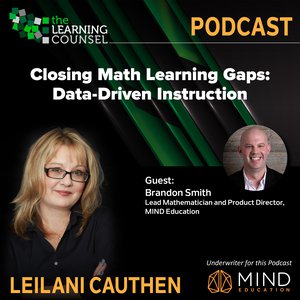
Closing Math Learning Gaps: Data-Driven Instruction
Math scores are down, and kids are still struggling at pre-pandemic levels, according to NAEP. District leaders need a solution now. In this episode, we tackle this issue head-on. Join us as we dive deep into practical actionable strategies you can implement immediately to address these challenges. We speak with Brandon Smith, a leading math expert on Neuroscience learning at MIND Education, about how to pinpoint specific learning gaps using readily available data, design targeted interventions, and monitor student progress effectively. This isn't just theoretical - we discuss real-world examples of how data-driven instruction has led to significant improvements in math achievement.
If you're a district leader, principal, curriculum director, or math coach concerned about student math performance, this episode is a must-listen. We provide concrete steps you can take today to start closing the math gaps and get students back on track.