
Concentric360 is Concentric Educational Solutions' integrated platform for connecting communities, schools, and young people to lasting opportunities. About 16% of young people ages 18 to 24 are disconnected from employment, education, or training, according to the Federal Reserve Bank of St. Louis, and that disconnection rarely traces back to one cause. Concentric360 addresses the full range of barriers through six coordinated modules: Action Center, Outreach Engine, Field Engagement App, Case Manager, Community Support Hub, and Digital Workforce Center. Automated, multi-language outreach engages families early, and when that outreach falls short, trained Professional Student Advocates step in through home visits to uncover the real circumstances behind disconnection. Then, young people are connected to the support needed to help them return to school, enter workforce training, or land a job. Concentric Intelligence, an AI layer built into the platform, tracks outcomes and generates board-ready reporting so leaders see real progress.
Formats/platforms used:
This is a web-based platform.
Primary URL:
https://concentriced.org/
Problem solved:
What a Student Information System Cannot Tell a District
A student information system can show a district that a ninth grader has missed fifteen days since September. It cannot show that her family moved twice in that span, that the second apartment is four bus transfers from school, or that she is the one getting her younger brother out the door every morning. None of that appears in a dashboard. It appears when someone sits down at a kitchen table and asks.
That conversation is the hardest part of attendance work, and it is the part districts have the least capacity for. A team of three cannot knock on four hundred doors. So outreach goes out, some of it lands, and the students who most need someone to show up are the ones least likely to answer a letter.
Concentric360, the platform Concentric Educational Solutions just launched, was built around that gap. Six coordinated modules carry a case from a first flag through a resolved barrier, and in some instances through to a first job.
How a case moves through the six modules
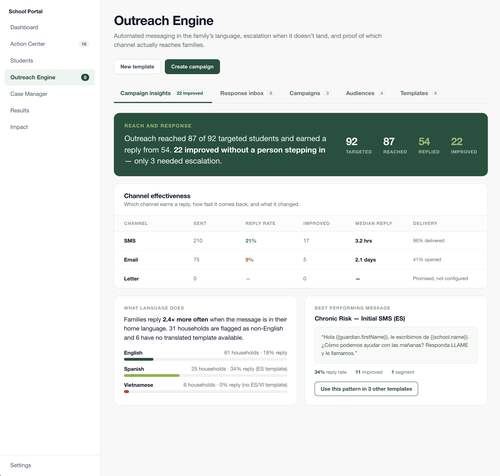
The first move is not a home visit. The Outreach Engine sends automated text, email, and letter outreach in the family's preferred language, timed early while a pattern is forming rather than after it has hardened. For a meaningful share of families, that is enough. A parent did not realize absences were accumulating, or did not know the school could help with transportation, and the student returns. The Outreach Engine also tracks which messages were delivered and opened, so a district knows the difference between a family that declined and a family that never received anything.
When outreach goes unanswered, Case Manager escalates the case and matches a Professional Student Advocate to the family by geography, language, and advocate capacity. It assigns the visit, monitors progress against the intervention timeline, and runs a quality review of visit fidelity before findings move any further. The module is the operational layer that makes escalation a defined process rather than an improvised one.
At the door, the advocate carries the Field Engagement App, a tool built for Professional Student Advocates conducting home visits and community engagement events. Consent-first, AI-assisted transcription keeps the advocate's attention on the family rather than a screen, and structured documentation captures barriers in a consistent form. GPS and offline sync verify visits in areas with limited connectivity, which matters in exactly the neighborhoods where this work concentrates.
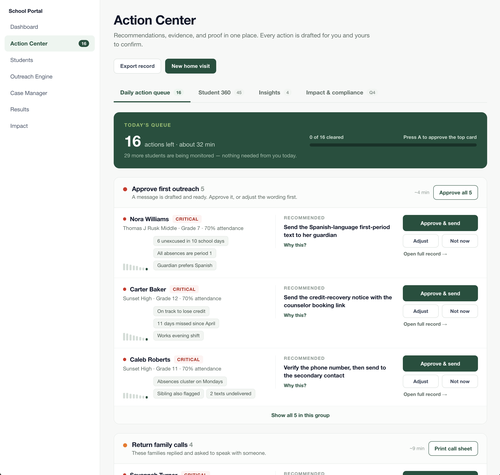
Findings land in the Action Center, the hub where a district works its caseload. An attendance lead sees a daily queue of flagged students, a recommended next step for each, and the reasoning behind the recommendation. Each student carries a complete record of every flag, every intervention attempted, the response to it, and home visit findings over time. An Impact and Compliance view produces outcome reporting and an exportable record of every engagement attempt, which is what a district needs when a case reaches a due process question. Recommendations arrive as recommendations. Every one can be approved, adjusted, or overridden by the person who knows the student.
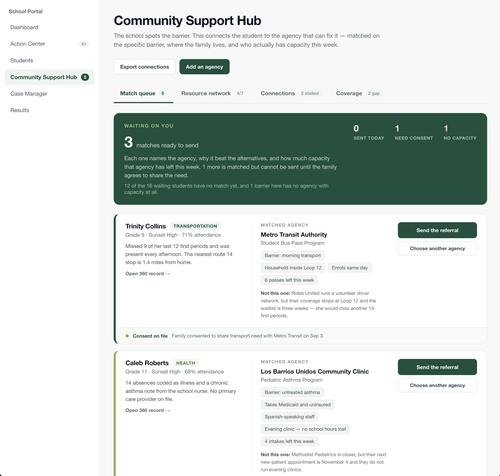
When a visit surfaces a barrier the school cannot resolve alone, the Community Support Hub takes it. Needs-based matching connects families to health, transportation, and family engagement services based on the specific barrier and location rather than a generic referral list, and impact reporting shows which of those connections actually moved attendance.
For students old enough that a return to the classroom is not the whole answer, the Digital Workforce Center opens career exploration, internships, apprenticeships, durable skills training, and industry mentorship. The module is where the platform's premise becomes visible, which is that reengagement is a beginning rather than the outcome.
Connecting all six is Concentric Intelligence, an AI layer that surfaces root-cause themes across students, identifies barriers clustering in particular neighborhoods or grades, and generates narrative reporting for boards and funders. Its operating principle is that AI recommends and people decide. Every output is labeled, sourced, and reviewable, and the platform makes no attendance, safety, or eligibility determination on its own.
The trust question
A platform that sends an advocate to a family's home invites an obvious set of questions, and Concentric's answers are worth putting on the record. Advocates are positioned as advocates rather than authorities, and the stated purpose of a visit is to understand a barrier, never to monitor a household. Recording during a visit is optional, and a family that declines receives the same support. Data handling is FERPA-aligned, governed, minimized, and access-controlled, and student data is not sold or used for marketing. Risk flagging is monitored for fairness across student groups, with human review built in.
Adoption pattern
Districts are not expected to deploy all six modules at once. Most begin with the one addressing their most pressing problem, whether that is the Outreach Engine easing the load on an attendance office running on three people or the Action Center producing the reporting a board has been asking for since the last budget cycle, and add the rest as it proves out. Existing home visit programs stay intact, with the rest of the platform built around them.
Grades and/or age range:
K-12 and beyond.
Pricing model(s):
Varies. Contact us at https://concentriced.org/contact to learn more.
What makes your product unique?
What sets Concentric360 apart is that it puts a trained person at the door and a career pathway at the other end, neither of which a notification platform can replicate.
The Outreach Engine handles volume first, with automated text, email, and letter outreach in a family's preferred language, and when that goes unanswered Case Manager escalates the case, matching a Professional Student Advocate to the family by geography, language, and capacity, then running a quality review before findings go anywhere. At the door, the Field Engagement App captures what is actually keeping a student out of school through consent-first, AI-assisted notes, whether that is housing, transportation, health, or caregiving. Everything lands in the Action Center, where a daily queue pairs each flagged student with a recommended next step and the reasoning behind it, alongside a complete record and exportable documentation of every engagement attempt.
When a barrier sits outside what a school can solve, the Community Support Hub connects the family to the agency that can, and tracks whether that connection moved attendance. The Digital Workforce Center then carries reconnection past the classroom door into career exploration, internships, apprenticeships, skills training, and industry mentorship, so the outcome is a credential or a first job rather than a restored attendance rate. Concentric Intelligence runs across all six, surfacing root-cause patterns and generating board-ready reporting measured against a baseline, while making no attendance, safety, or eligibility call on its own.
UI/UX:
Concentric360 is designed around role-specific surfaces, so a municipal leader, a school administrator, a program manager, and a Professional Student Advocate each see an interface built for the decision in front of them rather than a shared dashboard. The design principle running through it is recommendation with reasoning attached, meaning the Action Center pairs every flagged student with a suggested next step and the evidence behind it, so users act on a clear path rather than interpreting raw data, and field tools like the Field Engagement App reduce on-screen burden through AI-assisted transcription and offline sync so advocates stay present with families.