There is a difference between preparing a district for the future and designing a district that moves forward.
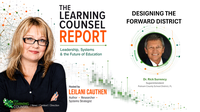
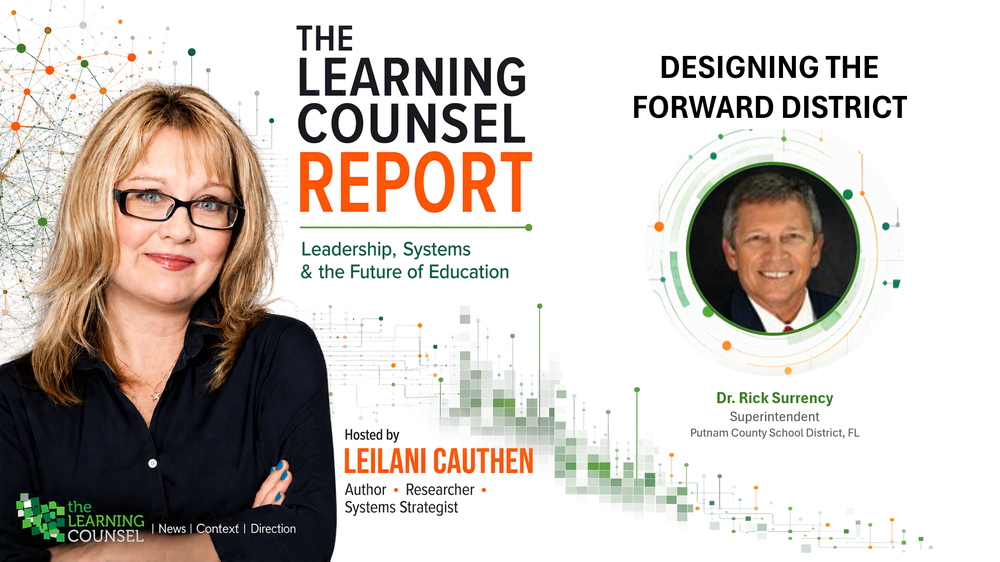
That distinction sits at the center of a wide-ranging conversation between Rick Surrency, Superintendent of Putnam County School District in Florida, and LeiLani Cauthen, CEO of Learning Counsel News Media and Research.
Rick Surrency is not approaching the subject as a theorist. He has spent 48 years in education and about a decade leading Putnam County. During his tenure, the district has undertaken a remarkable turnaround. Its graduation rate stood at just 54.9 percent in 2015. By 2025, it had reached 96.6 percent. Surrency credits deliberate K-12 early-warning systems, raised expectations and systematic approaches for helping change the trajectory.
That makes Putnam County an interesting place from which to ask the next question.
Once a district proves it can change a major outcome through systems, what should it redesign next?
The Work Around Teaching
One answer begins with human capacity.
Much of the work of teaching isn't visible when someone walks into a classroom. The visible portion is the interaction between teacher and students. Around it sits planning, assembling resources, navigating multiple systems, adapting instruction, distributing materials, responding to individual needs and managing the administrative machinery surrounding instruction. LeiLani Cauthen describes this in the conversation as the “work around the work.”
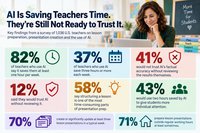
Rick Surrency sees technology, including AI, as a potential means of accelerating teachers' work rather than replacing it.
“I’m a big believer in...AI helping teachers to help students,” he says, emphasizing that teaching remains difficult and that educational leaders have a responsibility to find ways to make that work more manageable.
Putnam County has already attacked part of the problem organizationally. Teachers across the district gather by grade level or content area at least four times a year to plan together, identify gaps and share approaches instead of leaving every teacher to solve every instructional problem independently.
It leads to an important distinction for district leaders: teacher autonomy does not have to mean organizational fragmentation.
“Defined Autonomy”
Rick Surrency has a useful term for the balance: defined autonomy.
The district establishes the destination and certain non-negotiables, including the Florida standards students must master, while teachers retain room to determine how they get students there.
“We want our teachers to be creative,” he explains. “We want them to be able to bring their personality into the classroom,” while recognizing that certain expectations must remain consistent.
That idea may become increasingly important as districts move further into AI.
Automation can remove repetitive work. Digital systems can create greater consistency. AI can accelerate planning, differentiation and analysis. But greater operational coherence does not require eliminating the human variability that makes a classroom a human environment.
A Forward District may therefore need to do two things that have sometimes been treated as opposites: systematize more of the work while freeing more of the human.
AI Changes the Human Question
The conversation then moves beyond AI adoption itself.
Florida is already confronting governance questions. During the podcast, Rick Surrency discusses a Florida State Board rule requiring parental opt-in for student-facing AI tools. He also raises the familiar issues of student privacy, unreliable AI outputs, source validation and teaching students not to accept machine-generated answers uncritically.
Those are necessary questions.
But they may not be the biggest question.
AI literacy asks students to understand the machine.
The next educational question may be whether students understand themselves.
For generations, schools have concentrated extraordinary attention on language and mathematics. Those capabilities remain essential. Yet AI is becoming astonishingly capable in precisely those domains. That raises a provocative question for education: What happens if schools continue defining human capability primarily through the areas machines are becoming exceptionally good at?
The conversation turns instead toward recognizing other dimensions of human intelligence and asking whether schools can help students understand the ways they perceive, process, relate, create, move, imagine and act.
Surrency's response gets directly to the learner: it is valuable for human beings to understand how they themselves learn and process information. Students do not all process information in the same way.
That is a very different ambition from simply adding an AI tool to a classroom.
It changes what school is trying to develop.
Don't Put the Student Back in the Box
Florida's choice environment adds urgency to the issue.
Rick Surrency says operating in a choice state has already changed how the district thinks about doing business. Putnam County has become more attentive to customer service, marketing and, importantly, what it actually offers students.
His formulation is striking. What schools offer, he says, needs to “ignite their thinking.”
For students who think creatively or outside expected patterns, the answer should not be putting them “into a box” but finding ways to ignite their passion.
There are already glimpses of what that looks like in Putnam County.
Surrency describes collaborative projects among younger learners that allow students to create things together. He talks about interviewing students himself and seeing surprising creativity emerge from children whose ideas go well beyond conventional subject boundaries.
At the high school level, the range of possibility becomes even more tangible. Putnam County has students working toward private pilot licenses through a flight program.
These aren't simply “extras.” They suggest another way of thinking about the purpose of the enterprise.
A school system can deliver subjects. Or it can deliberately create environments in which young people discover what they are capable of doing with what they know.
The Lesson Surrency Brought Home From Finland
A visit to Finland several years ago reinforced that idea for Rick Surrency.
He recalls elementary students receiving approximately 15 minutes of free play every hour. To Surrency, the importance was not simply recess. It was what children were doing during that less-structured time: developing leadership, thinking freely and experiencing learning differently. He returned with a conviction that schools need to help children “free up their own minds” and avoid unnecessarily limiting their possibilities.
That is perhaps the deeper meaning of a Forward District.
It is not a district racing toward every new technology, abandoning standards, accountability or systems.
And it is not a district merely declaring itself “future ready.”
It is an organization willing to continually redesign the relationship between systems and people.
The Forward District Is Designed, Not Declared
What makes Rick Surrency's perspective especially relevant is that the conversation starts with evidence that redesign can work.
Moving graduation from 54.9 percent to 96.6 percent did not happen because Putnam County adopted a new slogan. The district put systems around a problem, established expectations and followed students early enough to intervene.
The next generation of district redesign may require the same discipline applied to different questions:
- Where is human effort being consumed by work that technology could carry?
- Where does individual teacher autonomy unintentionally create unnecessary duplication or fragmentation?
- What should remain distinctly human as AI becomes more capable?
- What forms of intelligence and ability are schools failing to recognize because they do not fit neatly into traditional measures?
- And how does a public school district become compelling enough that families actively choose it?
Rick Surrency's answer throughout the conversation is not a packaged formula. It is a disposition toward leadership: set expectations, build systems, protect the human element and remain willing to rethink what has always been done.
Perhaps his most important observation is also one of the simplest.
“Our role in all this,” he says of students' emerging creativity, “is we need to facilitate that. We need to give them the permission or the groundwork where they can do that.”
That may be the real work of designing a Forward District.
Not predicting the future for students but designing a system that gives them greater capacity to create it.
Can’t wait to read Rick’s new book!

You can find it here: https://www.ricksurrency.com/