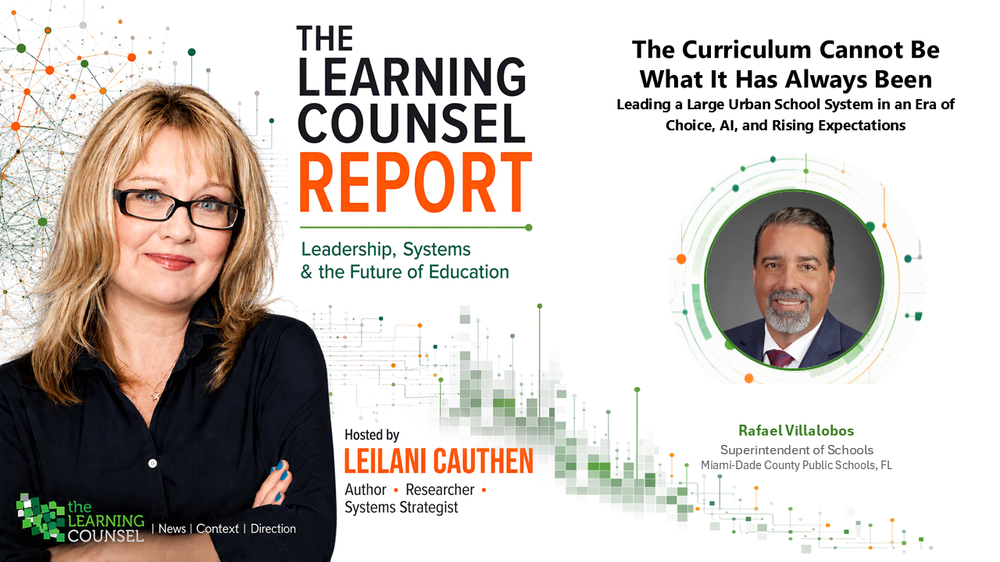
A conversation with Rafael Villalobos, Superintendent of Schools, Miami-Dade County Public Schools
Miami-Dade County Public Schools must be willing to reconsider its curriculum as artificial intelligence changes how students learn and the world for which schools are preparing them, Superintendent Rafael Villalobos said in a recent interview with The Learning Counsel Report.
“We understand that education has changed and will continue to change and that we must evolve with it,” Villalobos said. “Our curriculum cannot be stagnant. It cannot be what it has always been. We’ve got to be open to making that change.”
The statement came at the close of a wide-ranging conversation about teacher workload, artificial intelligence, academic expectations and the challenge of individualizing education in one of the nation’s largest and most diverse school systems.
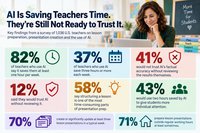
Villalobos enters the superintendency with a strong show of public support behind the district. Miami-Dade voters recently approved a bond measure by an 82 percent margin, which he described as the largest margin the district has seen and the largest across Florida.
“We definitely needed that for our teachers,” Villalobos said, noting the cost of living in Miami. “Our teachers need to be able to live here just like everyone else wants to come and live, work and play.”
The size of the vote, he said, speaks to “our voters and their trust and love for education and understanding that education is the key to our community and our society.”
That support arrives as the district confronts a more complex instructional environment. More than 160 countries are represented in Miami-Dade County, with more than 140 languages spoken, Villalobos said.
“It’s important that our teachers understand that professional development to assist us in these different languages spoken and how we understand cultures from these students that are coming from other countries also is a critical component,” he said.
Reducing the Work Around Teaching
That complexity is accompanied by growing accountability and administrative demands.
“Sometimes teachers are getting handed more and more and more work because the accountability continues to grow,” Villalobos said. “There are so many strategies out there that we have to try to reduce as much of the work as we possibly can to work smarter and not harder.”
Artificial intelligence could help, he said, but reducing teacher workload will also require districts to examine the systems and programs they already use.
“What are the programs that we currently use that we know that we may be duplicating, that is giving teachers more work on a daily basis?” Villalobos said. “We’re being very strategic through our strategic plan and very deliberate to reduce the amount of workload that teachers are having to do on a daily basis.”
He also pointed to the academic value of giving students feedback more quickly.
“The faster you give that feedback to the student, the faster that student understands what he or she did wrong,” Villalobos said. “Sometimes you take a day or two days and the student already forgot when they did that assignment.”
Immediate feedback, he added, allows a student to correct a misunderstanding while the work is still fresh.
“Being able to have that immediate feedback allows them to immediately change whatever it is that they were doing wrong,” he said. “I think that’s a strong component academically as well.”
Studying How Students and Teachers Use AI
Miami-Dade is already studying AI use rather than waiting for the technology to settle into schools on its own.
The district has partnered with Google and the University of Florida on research examining how students and teachers use Gemini.
“We are doing some really exciting stuff in Miami-Dade County,” Villalobos said. “There is a research component being done right now with how students and teachers use Gemini in Miami-Dade County.”
The study is designed to look beyond whether students use AI and examine how they apply it in specific subjects.
“If students are using it in mathematics, how are they using it in mathematics?” Villalobos asked. “If they’re using it for science, how are they using it? If they’re using it for dance, how are they using it?”
He said the findings should help the district make more deliberate decisions about professional development and instruction.
“That’s going to derive a lot of information that then is going to allow us to more strategically and methodically train teachers on how these students are using it and how we’re going to change the educational practices that happen in the classroom,” he said.
AI Needs Guardrails
Villalobos said AI’s growing presence in education does not mean students should be allowed to use it without limits.
“We also have to set certain guardrails around AI, and parents know that that’s important,” he said.
Students need to learn how to use AI without allowing it to replace the mental work required to develop knowledge, he said. It should not become a substitute for their ability “to learn cognitively, to memorize, to research, but not necessarily just get an answer.”
The challenge is therefore larger than adopting a particular AI product. Districts must decide when the technology supports learning, when it reduces unnecessary work and when it risks removing the thinking students need to do for themselves.
Individualizing the Educational Journey
For Villalobos, the longer-term opportunity is to create a more individualized educational experience involving students, teachers and parents.
“My vision is I see Miami-Dade County Public Schools, and I see our students and our parents and our teachers all engaged in the same process,” he said.
That process would not individualize only the student’s work. It could also help teachers understand how to teach each student more effectively.
“We’re individualizing each child, but not only the child, but the teacher as well and how the teacher teaches a child,” Villalobos said.
Beginning in kindergarten, he said, a system should develop a continuing understanding of how a student learns.
“How is it that this child is learning?” he asked. “What is it that this child is stronger in? What is it that this child has the most difficulty in?”
The technology should then adapt to support the student while also helping the teacher adapt, he said. It could preserve an instructional history that identifies unfinished learning and recurring gaps rather than forcing each new teacher to reconstruct that history.
Recognizing More of What Students Can Do
Individualization, in Villalobos’s view, should also include a broader understanding of student talent.
He compared the idea to identifying gifted students, who may demonstrate aptitude in several areas rather than only one.
“How do you exercise and promote that area that then kind of spills over into mathematics and science and social studies, regardless of what it is?” he said.
Schools should use the skills that make students distinctive as starting points for further learning, he said.
“It’s important that we use those skills that make them individuals and unique and that we are able to exploit and explore what else they can do with that, because that is really their true gift,” Villalobos said. “Sometimes we suppress that gift in education.”
Although schools have introduced group work, Socratic circles and other instructional strategies, Villalobos said the underlying model still does not meet the full range of present-day needs.
“It still doesn’t meet the demand of the 21st century and how we should be teaching children today and how we should be teaching individual children based on what they have talents in,” he said.
Doing that with one teacher responsible for all the variation within a classroom is extremely difficult, he added. Technology capable of differentiating education according to human development and talent could create “a win-win for everyone.”
Academic Achievement and Human Development
Villalobos also cautioned against treating academic achievement and human development as competing purposes.
“I think it’s actually sad that there are educational organizations and states that have abandoned the side of the emotional factor of creating a well-rounded human being and put so much emphasis only on the academic side,” he said.
Academic performance remains essential, particularly in a highly competitive global environment, he said. International comparisons in reading, mathematics and science should concern the United States. But academic achievement cannot be the only objective.
“There has to be a happy meeting somewhere,” Villalobos said. “That happy meeting also is that we are creating the next generation of human.”
Schools are preparing students to enter workplaces and communities where they will interact with other people, he said. That makes citizenship, awareness of others and the willingness to intervene when someone needs help part of the educational responsibility.
“Above and beyond the academics, we’ve got to make sure that we teach these students, all students from an elementary level all the way into high school, that they have to be good human beings as well,” Villalobos said.
“They have to be good citizens, and they have to make sure that they’re always on the lookout for the emotional well-being of others as someone would be on the lookout for their emotional well-being as well.”
An Opportunity to Reinvent
Despite the scale of the challenges, Villalobos described the present moment with optimism.
“It’s an exciting time to be a superintendent of schools because there is so much that is happening right now,” he said. “I only see these as opportunities for growth.”
The pressures confronting school systems, he said, are also opportunities to change them.
“Whatever these challenges are, they’re opportunities for growth,” Villalobos said. “They’re opportunities to reinvent ourselves, but ultimately for our children and making sure that our communities are going to benefit from this and ultimately our society and our country.”
For Miami-Dade, that reinvention reaches all the way to the curriculum.
“Education has changed and will continue to change,” he said. “We must evolve with it, and our curriculum cannot be stagnant. It cannot be what it has always been.”