There has been no shortage of promises about what artificial intelligence is going to do for teachers. Save time. Build lessons. Generate materials. Reduce administrative work. Maybe even give educators some portion of their evenings back.
A new survey from Decksy suggests some of that is actually beginning to happen.
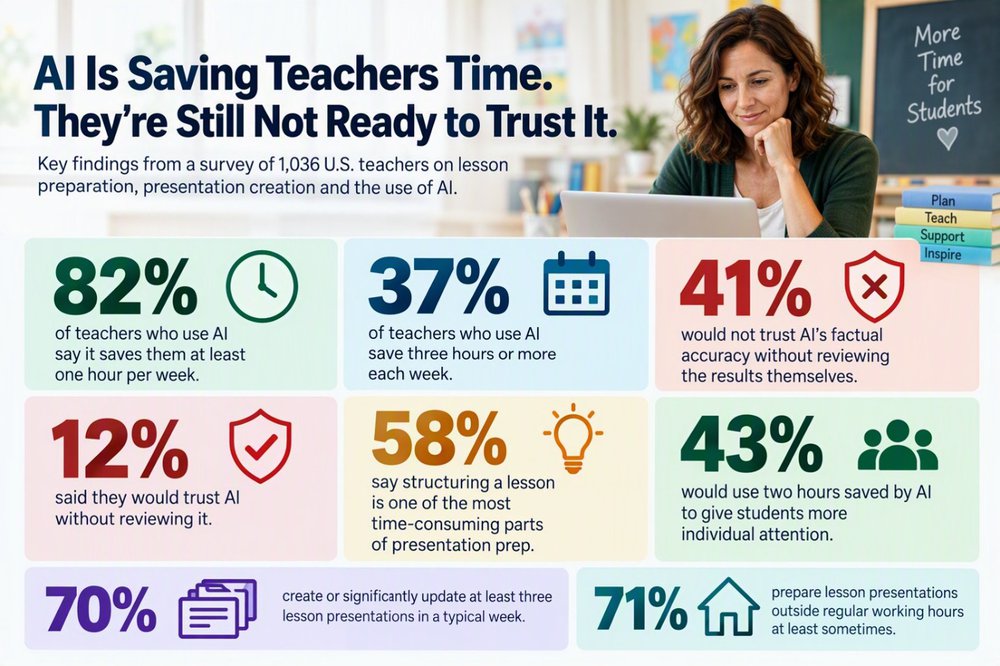
Decksy surveyed 1,036 full- and part-time U.S. teachers about lesson preparation, presentation creation and their use of AI. Among teachers who use AI, 82% said the technology saves them at least one hour per week, and 37% said it saves them three hours or more. [decksyai.com]
Three hours a week is nothing to dismiss.
But another number in the study caught my attention even more: 41% of teachers said they would not trust AI for factual accuracy without conducting their own final review. [decksyai.com]
That tells us something important about where we really are with AI in education.
Teachers are using it. They're getting value from it. They're saving time with it. But they're certainly not handing over the keys.
The Work Behind the Lesson
One of the more useful aspects of the Decksy study is that it looks beyond the presentation itself and into the work required to produce one.
Seventy percent of the teachers surveyed create or significantly update at least three lesson presentations in a typical week, while 71% said they prepare presentations outside regular working hours at least some of the time. [decksyai.com]
And apparently, it isn't making the slides look pretty that is consuming all that time.
Fifty-eight percent identified planning the structure of the lesson as one of their most time-consuming activities. After the presentation is finished, 69% spend another 30 minutes or more creating supporting materials. [decksyai.com]
That's the part of the AI discussion I think we sometimes miss.
We tend to look at teacher workload one task at a time. How long did it take to create the presentation? How quickly can AI generate a quiz? Can it create a worksheet? Can it summarize this material?
But a teacher doesn't experience those as isolated activities. They're all part of a workflow.
The lesson has to be structured. Materials have to be found or created. Content gets assembled. Supporting resources follow. Then everything has to make sense together and, ultimately, work for actual students.
Making one piece faster is useful. Making the whole sequence of work make more sense is something bigger.
Saving Time Is One Thing. Giving Capacity Back Is Another.
The trust finding makes this especially interesting.
AI can produce something in seconds, but if the teacher then has to review it for accuracy, correct it, fit it to the lesson, compare it with what students are supposed to learn and decide whether it's appropriate, some of the saved work comes right back in another form.
That isn't necessarily a criticism of AI. In fact, I think it's evidence that teachers understand their role pretty well.
Only 12% of the teachers surveyed said they would trust AI without reviewing its output, according to the study. [decksyai.com]
The teacher remains the responsible human in the loop.
But it does give district leaders something to think about as they evaluate the next generation of education technology.
Are we giving teachers AI so teachers can orchestrate AI?
Or are we designing systems intelligent enough to take more of the orchestration off the teacher?
There is a difference.
We spent much of the first generative AI wave thinking about individual tools: a teacher prompts something, AI produces something, and the teacher decides what to do with it.
The next question is whether AI can become part of better-connected instructional systems that reduce the amount of assembling, transferring, checking, coordinating and recreating that surrounds teaching in the first place.
That's where the human-capacity argument gets much more interesting.
Teachers Already Know What They'd Do With the Time
My favorite number in the study may actually be 43%.
Decksy asked teachers what they would do if AI gave them two additional hours each week. Forty-three percent said they would use the time to provide students with more individual attention. [decksyai.com]
There it is.
Not more AI.
More teacher.
That's ultimately why the conversation about teacher productivity needs to be handled carefully. The goal isn't to squeeze more output from an already overloaded profession. If technology can remove some of the mechanics surrounding teaching, the prize is the recovery of human capacity for the parts of education where humans matter most.
A teacher sitting beside a struggling student.
A conversation that uncovers why a student isn't understanding.
A teacher noticing that a lesson isn't landing and changing direction.
More time to think, prepare, respond and teach.
Those are difficult things to manufacture with a productivity tool.
Now Ask the Bigger Question
The Decksy numbers are encouraging. Teachers using AI report meaningful time savings, even while maintaining a healthy degree of skepticism about what the technology produces. [decksyai.com]
But I'd argue that the next stage shouldn't be measured simply by how many teachers use AI or how many minutes a particular application saves.
We ought to start looking at the architecture surrounding the teacher.
Where is the unnecessary work coming from? How much is caused by disconnected systems? How much human time is being spent moving information, creating derivative materials, checking outputs and coordinating technology that was supposedly purchased to make work easier?
And then comes the question that matters:
How much of that work can the system take back?
Because if AI gives teachers three hours back only to introduce a new collection of things they have to check, manage and orchestrate, we've improved the tool without necessarily fixing the work.
But if we can use this technology to steadily remove the work around teaching, then those saved hours become something far more valuable than an efficiency metric.
They become time with students.
And according to these teachers, that's exactly where many of them would put it.
Source: Decksy,“The hidden work behind lesson presentations. What do teachers really spend their time on?” by Alyssa Johnson, published October 12, 2026. Decksy reports that the study surveyed 1,036 current full- and part-time teachers in the United States. [decksyai.com]