For years, K-12 schools have been told that the problem was digital adoption. Get devices. Buy platforms. Add apps. Digitize curriculum. Move assignments online. Build dashboards. Track usage.
Now, after the pandemic-era surge of technology spending and the return of tighter budgets, the conversation has shifted. Districts are asking how many applications they really need. Leaders are looking at license usage, login counts, renewal costs, and app redundancy. In many places, the new strategy is simple: find the apps used least, cut them, and call that coherence.
But that approach misses the largest hidden cost in the system.
The real problem is not merely that schools have too many apps. The real problem is that instruction itself remains disordered. Teachers are still the human integration layer between curriculum maps, pacing guides, digital resources, worksheets, assessments, communication tools, classroom routines, intervention needs, and the daily reality of students.
In other words, districts may be reducing app counts, but teachers are still building instruction.
The Hidden Labor Underneath “Curriculum”
Learning Counsel’s national research has pointed to this issue for years. In the 2023 Learning Counsel National Research Survey of K-12 schools, the data showed that teachers spend large amounts of time not only teaching, but finding materials, building lessons, sequencing content, managing assignments, dealing with logins, monitoring software, communicating with parents, tracking student work, and moving across systems.
The survey grouped these into three major digital tasks: finding digital lesson materials, building digital content and lesson sequences, and managing digital traffic. Teachers reported very high weekly time burdens for these activities: 26% said they spent 6-15 hours per week, 27% said 15-30 hours, and 24% said more than 30 hours per week on these tasks.
That means a majority of teachers reported spending more than 15 hours a week on work adjacent to instruction rather than direct live teaching with students. [rand.org]
This is the part of school operations that rarely appears on a budget line. A district may know what it spends on curriculum licenses, learning applications, assessment tools, devices, and major systems. It may even know which apps are underused. But it usually does not calculate the amount of teacher labor required to assemble all of those pieces into usable daily instruction.
That is the elephant in the room.
Many schools still treat curriculum as a map rather than a fully built instructional system. Learning Counsel’s survey described several operating models: teachers doing all lesson planning and choosing digital resources; districts issuing pacing guides and playlists while teachers complete the lesson build-out; districts issuing pacing guides only while teachers do all planning; and, less commonly, centralized planning of digital resources and lessons arranged into courses. [rand.org]
That distinction matters. A curriculum map is not a lesson. A pacing guide is not a teachable sequence. A playlist is not an instructional experience. A standards alignment document is not a classroom-ready course.
When districts say they “have curriculum,” what they may actually have is a skeleton. Teachers are still adding the muscles, connective tissue, pacing, activities, checks for understanding, transitions, accommodations, interventions, assignments, and assessments.
The Teacher as the Integration Layer
The Learning Counsel data also showed that a significant portion of teachers still build digital lessons from their own knowledge, textbooks, open-internet resources, social media, subscription sites, approved repositories, apps, courseware, and mixed materials.
In the survey, 26% of teachers were cited as custom-building digital lessons from their own knowledge or textbooks, 13% used the open internet, social media, and teacher subscription sites to gather materials, 18% used approved repositories or full lesson constructs, 36% used some mix of approved materials and build-their-own pieces, and only 7% primarily coached students through existing online courses, apps, or courseware.
That means the prevailing instructional model is still artisan assembly. Teachers are not simply delivering a coherent curriculum. They are often manufacturing it.
This is not because teachers are careless or resistant. It is because the system has made them the point of synthesis. They must reconcile what the district adopted, what the school expects, what students need, what the available tools allow, what the pacing guide says, what the assessment demands, and what they can realistically manage by tomorrow morning.
This becomes even more complicated when curriculum exists across print materials, digital resources, PDFs, videos, LMS pages, assessment tools, intervention apps, data dashboards, and teacher-created files. The burden is not just instructional. It is logistical and administrative.
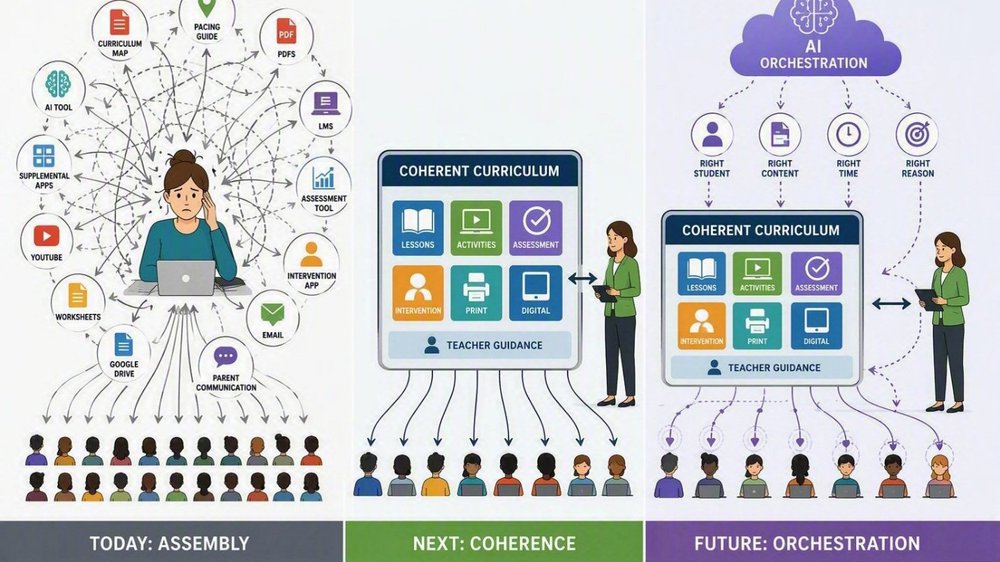
A teacher may be working from a print textbook, a district pacing guide, a Google Drive folder, an LMS, a supplemental math app, a reading intervention platform, a formative assessment tool, a parent communication app, and a personal library of slides and worksheets. The official curriculum may be only one piece of the real instructional environment.
This is why app consolidation alone is insufficient.
What Has Changed Since 2023?
Not enough.
Recent national research suggests that the same underlying pattern continues. RAND’s 2025 analysis of teacher instructional-material use from 2019-2024 found that most teachers continue to mix and match multiple materials. On average, teachers reported regularly using two curriculum materials and five supplemental materials. Nearly half of teachers reported using curriculum material they created themselves, and nearly all teachers reported modifying their curriculum materials. RAND also found that teachers using new instructional materials spent additional weekly time on instructional planning compared with peers who were not using new materials.
This is important because it shows the problem has not disappeared with more curriculum adoption. Even when schools adopt standards-aligned or district-recommended materials, teachers still supplement, modify, and create. RAND’s 2023 work similarly noted that adopting standards-aligned materials is only the first step, and that getting teachers to use materials consistently and with integrity remains a challenge.
Pew Research’s 2024 national teacher survey reinforces the workload side of the issue. Pew found that 84% of public K-12 teachers say they do not have enough time during regular work hours to complete tasks such as grading, lesson planning, paperwork, and answering emails. Pew also found that 77% of teachers say their job is frequently stressful and 68% say it is frequently overwhelming.
So yes, districts are more aware of app overload. But no, the underlying instructional labor problem has not meaningfully been solved.
The Real App Numbers
- Instructure / LearnPlatform Findings
Instructure's 2025 EdTech Top 40 report found that districts accessed an average of 2,982 distinct edtech tools annually. The study analyzed 64 billion interactions across 3.7 million students and 546,000 educators. On average, students accessed 1,165 tools monthly and teachers accessed 1,045 tools monthly across district ecosystems.
Then the 2026 Instructure analysis found districts maintained access to an average of 3,001 unique digital tools per district, even though students and educators interacted with only about four integrated tools on average through Canvas LTI workflows.
That is an extraordinary finding because it suggests: Districts have accumulated thousands of tools, while actual instructional activity concentrates around a tiny subset.
- Lightspeed Findings
Lightspeed's 2026 EdTech App Report found districts manage an average of 2,744 applications per network. Their report explicitly states that the volume exceeds what any team can manually track and requires automated visibility and governance.
- ClassLink
ClassLink itself is somewhat different because they don't publish a simple annual "average apps per district" figure. What they emphasize is that districts need analytics because they are managing hundreds or thousands of digital resources and need visibility into true usage, engagement, and ROI. Their entire analytics platform is positioned around understanding usage across large app ecosystems.
The New Budget Response: Cut Apps
With budgets tightening, districts are now trying to rationalize their digital ecosystems. On the surface, this is reasonable. Many schools do have too many tools. A 2025 App Overload report from Cornerstone Communications and Edsby found that many schools use 10-15 educational apps, creating fragmented experiences for teachers, parents, and students. Teachers reported that multiple platforms increase administrative work and require them to move between separate systems for instruction, assessment, communication, and data.
THE Journal’s reporting on the same study noted that 54% of respondents said their schools used 10-15 officially sanctioned educational apps, 40% accessed apps individually, and only 10% relied solely on a unified app portal. Teachers cited fragmented functionality, administrative disruption, and lack of integration as common complaints.
It makes sense that districts want to reduce redundancy. But the danger is that leaders may confuse usage analytics with instructional coherence.
A high-use app is not automatically instructionally essential. A low-use app is not automatically unnecessary. Usage tells leaders what people are clicking. It does not tell them whether the instructional architecture makes sense.
If a district simply asks, “Which apps are used the most?” it may preserve the most habitual tools while eliminating specialized resources that serve specific instructional purposes. Worse, it may leave intact the basic disorder: curriculum in one place, assignments in another, assessments elsewhere, communication somewhere else, data in a dashboard, interventions in separate programs, and teacher-created materials scattered across personal accounts.
The district may cut costs, but the teacher still has to assemble the instructional day.
The Difference Between App Consolidation and Instructional Coherence
This is the key distinction.
- App consolidation asks: How many tools are we paying for?
- Instructional coherence asks: How much of the teaching and learning sequence is already organized for use?
- App consolidation asks: Which platforms are used most?
- Instructional coherence asks: Which resources actually form a complete lesson, unit, course, assessment path, and intervention structure?
- App consolidation asks: Can we reduce licenses?
Instructional coherence asks:
- Can we reduce the amount of hidden labor required from teachers?
- Most districts are now doing the first. Far fewer are doing the second.
This matters because a district can reduce from 15 apps to 8 and still leave teachers with the same core burden: build the lesson, find the resources, adapt the assignment, align the standard, post the activity, monitor the tool, check the data, message the parent, and repeat tomorrow.
The number of apps is only one symptom. The deeper disease is lack of instructional order.
Why Print-Plus-Digital Core Curriculum Matters
This is where a print-plus-digital, non-fragmented core curriculum model has a stronger market story than simply “digital curriculum” or “all-in-one platform.”
The first wave of edtech digitized content. The second wave added applications. The third wave is now trying to consolidate tools. But the next wave must organize instruction itself.
A coherent print-plus-digital core curriculum does more than provide materials. It gives schools a structured instructional path that connects:
- standards,
- curriculum maps,
- lesson sequences,
- teacher-facing guidance,
- student-facing materials,
- print resources,
- digital activities,
- assignments,
- assessments,
- progress monitoring,
- intervention supports,
- and classroom workflow.
That is different from giving teachers a repository. It is different from giving them an LMS shell. It is different from giving them a pacing guide plus a pile of links.
The strategic value is that it reduces the need for every teacher to become a curriculum engineer.
For Kiddom, this is the sharper story: Kiddom is not merely another digital resource. It can be positioned as an answer to the disorder created when curriculum, instruction, assessment, and digital workflow have been separated across too many tools and too much teacher labor.
The promise is not just “fewer apps.” The promise is less assembly.
A New Category of AI-Enhanced Digital-Plus-Print Core Curriculum Is the Next Evolution
From the Learning Counsel Research view, the market is moving beyond the first digital curriculum era. The issue is no longer whether schools have digital content. They do. The issue is that the content, tools, assessments, teacher planning, student work, and print resources are still scattered across too many disconnected places.
This is why app reduction by usage counts is an incomplete answer. A district can remove underused applications and still leave teachers with the central burden: assembling instruction from fragmented pieces. The deeper problem is not merely application overload. It is the lack of instructional order.
Learning Counsel Research would describe the next category as:
AI-enhanced digital-plus-print Core Curriculum: a coherent instructional system that connects print, digital, assessment, teacher guidance, student activity, and adaptive planning into one organized curriculum experience.
Kiddom can be used as an example of this next-level curriculum approach, not because it is simply “digital,” but because it points toward a more complete model of curriculum coherence. In this model, curriculum is not merely a map, a pacing guide, a repository, or a collection of resources. It is an organized instructional flow that specifies what happens before, during, and after the teacher’s intersection with the full curriculum.
That specificity matters.
Traditional curriculum often stops short of the classroom moment. It may tell teachers what standards to cover, which unit comes next, what materials are available, and which assessments are recommended. But it frequently leaves the teacher to determine:
- how the lesson opens,
- what sequence of activities should occur,
- when students move from print to digital,
- which assignment connects to which objective,
- how formative checks are used,
- what intervention or extension follows,
- how digital work is monitored,
- and how the whole thing becomes a coherent instructional day.
The next category should reduce that ambiguity.
An AI-enhanced digital-plus-print Core Curriculum should provide a more scripted default path, while still preserving professional leeway for teacher judgment. This is not a rigid “teacher-proof” curriculum. It is a structured curriculum architecture that gives teachers a complete instructional spine.
The model should say, in effect:
- Here is the intended learning sequence.
- Here is the teacher move.
- Here is the student task.
- Here is the print resource.
- Here is the digital activity.
- Here is the formative check.
- Here is the likely adaptation.
- Here is where the teacher may adjust.
That is a very different market position than “we offer digital resources.” It is closer to saying: We reduce fragmentation by organizing the full instructional act.
The category need is clear: schools do not simply need more content or fewer applications. They need a curriculum model that lowers the teacher’s assembly burden while raising instructional consistency.
What’s interesting is that Kiddom represents an emerging category of AI-enhanced digital-plus-print Core Curriculum, designed to move schools from fragmented materials and teacher-built lessons toward coherent, standards-aligned, classroom-ready instructional sequences with room for teacher adaptation.
This gives Kiddom a better strategic lane. It is not only a curriculum company. It is not only a platform. It is not only print plus digital. It is part of the next curriculum architecture: one that integrates the full instructional path and clarifies the teacher’s point of action inside that path.
The key distinction is this:
Old model:
Curriculum map + teacher assembly + scattered apps + supplemental materials + separate assessment.
Next model:
AI-enhanced digital-plus-print Core Curriculum with scripted instructional flow, embedded teacher guidance, connected student activities, aligned assessment, and adaptive leeway.
That is the coherency story.
And it is the one districts need now, because cutting low-use apps will not automatically create instructional order. Only a more complete curriculum architecture can do that.
Districts are trying to solve fragmentation by counting apps. But the real fragmentation is instructional. Teachers are still building the bridge between curriculum, resources, assignments, assessment, and student progress every day.
Kiddom’s value is not just that it can help districts simplify their technology stack. Its deeper value is that it can help districts move from curriculum as a map to curriculum as an operating system.
In a fragmented model, the workflow looks like this:
Curriculum map → pacing guide → teacher-created lesson → internet search → PDF → video → LMS → assessment tool → gradebook → parent communication → intervention app.
In a coherent model, the workflow should look more like this:
Core curriculum → lesson sequence → print and digital activities → assignment → assessment → progress evidence → instructional adjustment.
That is the difference between a digital pile and an instructional system.
The Leadership Question Districts Should Be Asking Right Now
Instead of asking only, “Which apps are used most?” districts should ask:
- Where does the actual lesson get built?
- Who sequences the learning experience?
- How many systems does a teacher touch to deliver one unit?
- How much time is spent finding, adapting, and transferring materials?
- Are teachers using a common instructional path or individually assembling one?
- Does the adopted curriculum include classroom-ready digital and print execution?
- Can leaders see what is actually being taught, assigned, assessed, and adjusted?
- Are app decisions being made around instructional design or simply usage volume?
These are the questions that expose the real cost.
The Problem Is Not Just Too Many Apps
The current budget moment may push districts toward smarter purchasing. That is useful. Some app redundancy should be reduced. Some tools should go away. Some contracts should not be renewed.
But if the only lens is usage, districts will miss the bigger opportunity.
The real work is not just cleaning up the app list. It is rebuilding instructional order to fit the times.
They need curriculum that is already organized for teaching and learning.
They need print and digital resources connected in one coherent instructional flow.
They need assessment and progress data attached to the learning sequence, not floating beside it.
And most of all, they need to stop pretending that a curriculum map is the same thing as instruction.
The next great efficiency in K-12 will not come from deleting tools from a dashboard. It will come from reducing the hidden teacher labor required to turn fragmented curriculum assets into teachable, assessable, adjustable learning experiences.
And Then the Final Level: AI Orchestration
The next evolution of curriculum is not simply fewer applications, more content, or even tighter integration.
After the baseline of actual instructional coherency and reduced teacher burden, the next evolution is AI orchestration. AI orchestration will provide the last mile of additional recommendations for unique cases and the dynamism to the teaching and learning that fits the human condition.
For more than a decade, education technology has focused on digitizing resources and expanding access. Schools accumulated learning management systems, curriculum products, assessment platforms, intervention tools, communication apps, productivity suites, and specialized instructional software. The result was a dramatic expansion of digital capability, but also a dramatic increase in complexity. Recent industry analyses show districts now manage thousands of digital tools across their ecosystems.
The challenge is that access does not equal coordination.
Simply having thousands of available resources does not help teachers determine which activity should occur next, which intervention is appropriate, which resource should be assigned, or how to personalize instruction efficiently for dozens or hundreds of learners.
This is where AI orchestration becomes the next next major category after at least getting true coherence.
Teachers will then find that AI is the help they really wanted. Instead of asking them to search through repositories, compare resources, monitor multiple systems, and manually determine next steps, the system itself becomes an intelligent coordinator.
At the level of cross-system orchestration, AI is not replacing teachers. It is reducing the mechanical labor surrounding teaching.
The opportunities include:
- Recommending the most appropriate lesson, activity, or resource based on learner progress and tutoring within coherent instructional Apps.
- Identifying students who need intervention before they fall significantly behind and recommending earlier modules within instructional Apps or separate Apps or content.
- Suggesting outside enrichment opportunities for students who are ready to accelerate.
- Automatically connecting standards, curriculum, assessments, and learning activities in real-time happening as updates or local activities.
- Recommending the best instructional grouping or peer collaboration opportunities, even across multiple campuses or geographies.
- Surfacing alternative relevant digital tools only when they provide meaningful value.
- Reducing time spent searching, organizing, assigning, monitoring, and reassigning resources.
- Automating administrative workflows that currently consume teacher planning time.
From a Learning Counsel Research perspective, this represents a fundamental shift away from today's tool-centric model.
Current Model:
Teacher → searches for resources → selects apps → builds lessons → assigns work → monitors students → determines interventions → repeats.
AI-Orchestrated Model:
Curriculum → student evidence → AI recommendation engine → dynamic teacher review and adjustment → personalized student experience.
In other words, the teacher moves from being a full-time assembler of instruction to being a strategic instructional decision-maker while also teaching.
This is the best positioning for AI in the complexity of schools today. Not generating content totally independently of being integrated into the workflow of real life teaching but reducing the hidden time-wasters that prevents educators from spending precious minutes directly supporting students. AI, after all, should pave the way for more human interaction. That is the promise of AI, of coherency to the operational construct that makes it so humans can be more human.
The long-term goal is not personalization for a handful of learners while teachers do a mad scramble to pull that off navigating between numerous resources on the fly. It is personalization at scale.
Historically, true personalization has been difficult because every variation required additional teacher time. Different assignments, different resources, different pacing, and different interventions created additional workload. AI orchestration changes that equation by continuously evaluating learner evidence and recommending adaptive pathways while keeping the teacher in control of final decisions.
As AI-enhanced digital-plus-print Core Curriculum emerges as a new category, orchestration becomes its defining capability. The curriculum is no longer a static sequence of lessons. It becomes a dynamic instructional framework that continuously coordinates content, activities, assessment, intervention, teacher guidance, and student progress.
The future is an orchestrated learning ecosystem in which curriculum, technology, and instructional decisions work together intelligently to reduce teacher labor, increase coherence, and enable meaningful personalization across entire schools and districts. For education systems seeking both efficiency and improved outcomes, AI orchestration may become the most important advancement since curriculum itself.
Sources:
Learning Counsel Research, 2023, https://thelearningcounsel.com/articles/learning-counsel-unveils-key-insights-at-the-10th-annual-k-12-strategies-survey-results-awards-event/
https://www.rand.org/content/dam/rand/pubs/research_reports/RRA100/RRA134-30/RAND_RRA134-30.pdf
https://www.pinterest.com/pin/190136415509639235/
https://www.classlink.com/products/analytics-plus
https://www.publicnow.com/view/6DBF40ECBE288B710D19DE9E7480D6582176951D