Since at least the 1960s, the connection between education and economic outcomes has been the subject of substantial research—both theoretical and empirical. Economists have long demonstrated that higher levels of education are associated with increased productivity, higher earnings and stronger economic growth. Measures such as years of schooling, graduation rates and degrees attained have served as key indicators of human capital and economic potential.
But a growing body of research is now reframing this relationship in important ways. The connection between education and economic success is increasingly understood to be driven by the capacity of the human brain, including both brain health and brain skills.
The Rise of the Brain Economy: Reframing the Connection between Education and Economics
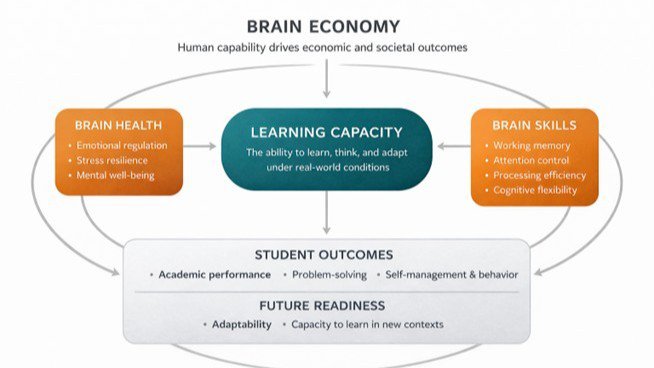
The current shift is reflected in the emergence of what economists and global organizations describe as the “brain economy.” In this economy, human capability, notably brain health and brain skills, is the primary driver of productivity, innovation and societal well-being.
As McKinsey & Company explains, “We’re homing in on this notion of brain capital—that what we bring through our brain health and brain skills is a valuable asset. That is, valuable at an individual level, an employer level and at a societal level.”
Importantly, this concept of brain capital encompasses two closely related dimensions:
- Brain health – including mental well-being, emotional regulation and the absence of conditions that impair cognitive functioning
- Brain skills – the cognitive processes that enable learning, thinking, and problem-solving
These two dimensions are particularly relevant for education.
Schools across the country continue to grapple with concerns about student mental health and well-being, alongside persistent challenges in academic performance. These are often treated as separate issues—but from a brain economy perspective, they are deeply connected.
Mental health influences how effectively students can engage their cognitive skills.
At the same time, cognitive skills, such as attention control, cognitive flexibility and inhibitory control, play a role in how students manage stress, behavior and emotional demands.
Together, brain health and brain skills form the foundation of learning capacity.
The Overlooked Connection Between Mental Health and Cognitive Function
Large-scale research has identified a consistent relationship between mental health challenges and reduced cognitive efficiency across a wide range of conditions, from everyday anxiety and stress to more significant disorders. Researchers have described this as a general cognitive impact, sometimes referred to as a “C-Factor,” reflecting the measurable effects of mental health on cognitive functioning.
These effects commonly include:
- Reduced attention
- Weaker working memory
- Slower processing speed
- Diminished executive functioning
Importantly, these effects are not limited to diagnosable conditions. Even moderate levels of stress or emotional strain can impair the brain’s ability to process and use information efficiently. This research helps explain patterns educators frequently observe:
Students who:
- Know the material but cannot demonstrate it consistently
- Struggle to sustain attention or complete tasks
- Become overwhelmed under pressure
- Exhibit frustration that leads to disengagement or behavioral challenges
These are often interpreted as either academic or behavioral issues. But in many cases, they reflect the interaction between mental well-being and cognitive capacity.
A Two-Way Relationship
The relationship between cognitive skills and mental health is not one-directional. Mental health challenges can impair cognitive functioning—but the reverse is also true.
When cognitive skills are weak:
- Learning requires greater effort
- Tasks take longer and consume more mental energy
- Errors and inconsistencies increase
- Students experience repeated frustration
Over time, this can contribute to:
- Increased stress
- Reduced confidence
- Avoidance of learning situations
Conversely, when cognitive skills are stronger, students are often better equipped to manage the demands of learning, which can support greater confidence and resilience.
From this perspective, the rise in both learning struggles and mental health concerns in schools may not represent two separate challenges, but different expressions of the same underlying issue: insufficient development of the brain’s capacity to function efficiently under increasing demands.
A New Question for Education
If economic growth depends not only on education but on the cognitive and emotional capacity that underlies it, this raises an urgent question for education systems: Are we developing the brain health and brain skills students need—not just to learn today, but to adapt, think and succeed over time?
For decades, education has been shaped by the demands of the knowledge economy, where access to information and mastery of content were primary goals. But that model is no longer sufficient. What increasingly matters is not just what students know, but how effectively they can learn new information, integrate ideas across contexts, solve unfamiliar problems and adapt to changing demands. These are not content skills. They are the combined expression of brain health and cognitive skills.
The Hidden Infrastructure of Learning
Every educator has seen it. Two students receive the same instruction. One thrives. The other struggles.
The difference is rarely effort or motivation alone. It lies in the efficiency of the brain’s underlying processes, the cognitive skills that support learning. These include:
- Working memory – holding and manipulating information in mind
- Attention control – sustaining focus and resisting distraction
- Processing speed – efficiently taking in and responding to information
- Cognitive flexibility – shifting strategies and perspectives
- Visual and auditory processing – making sense of incoming information
Together, these and other cognitive skills form the brain’s learning infrastructure. When this infrastructure is strong, students learn more efficiently, retain more and apply knowledge more effectively. When it is weak, learning becomes slow, effortful, and often frustrating, regardless of the quality of instruction.
The Growing Gap Between Instruction and Capacity
This creates a widening and increasingly consequential gap in education. On one side, schools continue to improve instruction and expand access to information. On the other, many students lack the cognitive efficiency needed to fully benefit from those improvements.
Schools are also experiencing a steady rise in students who struggle to learn, reflected in the increase in the percentage of students classified as special education, along with increasing demands on intervention systems, staffing, and resources.
Schools have expanded instructional supports, targeted interventions, accommodations, and have even overhauled reading instruction in response to the mandates emerging from the consensus on the Science of Reading.
These approaches are necessary—but they often focus on what students are expected to learn, rather than the capacity with which they are learning. Without addressing this underlying capacity, even well-designed interventions may yield limited results.
AI as an Accelerant
Artificial intelligence is accelerating these dynamics. As access to information becomes nearly unlimited, the value of what students know is changing. At the same time, the demands on how students think are increasing.
Now Students must:
- Evaluate the accuracy of AI-generated information
- Integrate ideas from multiple sources
- Make decisions in ambiguous situations
- Apply knowledge in novel contexts
These demands increase cognitive load, not decrease it. They place greater demands on cognitive skills, especially executive functions (working memory, inhibitory control and cognitive flexibility).
In this context, AI does not reduce the importance of human thinking. It increases the demands on it.
From Content-Centered Education to Capacity-Centered Learning
The growing gap between instruction and learning capacity is not just a challenge. It is the defining issue in education today.
For decades, education has largely been content-centered, focused on delivering curriculum, ensuring coverage and measuring what students know. This approach made sense in a knowledge economy, where access to information was limited and mastery of content was a primary goal.
But in the brain economy—where the ability to learn adapt, and apply knowledge is paramount—this model is no longer sufficient. A new paradigm is emerging: from content-centered education to capacity-centered learning
In this model, the central question is not simply What are students learning, but How effectively are they able to learn—and under what conditions?
This distinction matters. Learning does not occur in a vacuum. It depends on both:
- the efficiency of cognitive processes
- the state of brain health, including the ability to manage stress, sustain effort and regulate attention and behavior
When cognitive skills are strong and brain health is supported:
- Students learn more from the same instruction
- Knowledge is retained more effectively
- Skills transfer more readily across contexts
When either is compromised, learning becomes less efficient, more effortful, and more fragile.
A capacity-centered approach therefore reframes the role of education. Instruction remains essential—but it must be paired with intentional development of both brain skills and brain health. This shift towards developing learning capacity is reflected in emerging approaches that focus directly on strengthening the cognitive processes that underlie learning.
From Preparing for Work to Preparing for an Uncertain Future
The purpose of education has not changed. It has always been to prepare students for the future. What has changed—profoundly—is the nature of that future.
For generations, education has been closely tied to workforce preparation. Schools were expected to equip students with the knowledge and skills needed for defined roles in a relatively stable economy.
That stability no longer exists.
Today’s students are entering a world where:
- Career paths are less predictable
- Job roles are rapidly evolving
- Entire industries are being reshaped by technology
- Many future jobs have yet to be defined
This uncertainty carries an important, often overlooked implication:
It increases cognitive and emotional demands on learners.
Navigating ambiguity requires more than knowledge. It requires the ability to process complex and sometimes conflicting information, make decisions without clear answers, adapt quickly to new expectations and persist in the face of uncertainty.
These demands place pressure not only on cognitive skills, but also on brain health.
Uncertainty can increase stress. Stress, in turn, can impair attention, working memory and decision-making.
In other words, the very conditions that define the future also make it more difficult for students to use the cognitive skills they need to succeed.
Conclusion: The Central Challenge of the Brain Economy
In this context, preparing students for the future is not about predicting what they will need to know. It is about ensuring they have the capacity, both cognitively and emotionally, to learn whatever they will need to know.
The emergence of the brain economy reframes the role of education in a fundamental way.
The goal is no longer simply to deliver knowledge. It is to develop the human capacity that makes knowledge usable, especially under conditions of complexity, change and uncertainty.
This includes both:
- Brain health—supporting the mental well-being necessary for effective functioning under stress
- Brain skills—the cognitive processes that enable learning, thinking and problem-solving
Together, these form the foundation of learning capacity—and, ultimately, of economic and societal well-being.
If the future demands greater adaptability, resilience and continuous learning, then strengthening this capacity is not optional. It is essential.
As McKinsey & Company emphasizes:
“Investing in brain health and brain skills is one of the highest rated return investments we can make—both for individual wellbeing and for society and economic growth.”
The question is no longer whether schools can afford to invest in learning capacity, but whether they can afford not to.
For education leaders, this represents more than an insight—it is a call to action.
About the authors

Betsy Hill is President of BrainWare Learning Company, a company that builds learning capacity through the practical application of neuroscience. She is an experienced educator and has studied the connection between neuroscience and education with Dr. Patricia Wolfe (author of Brain Matters) and other experts.

Roger Stark is Co-founder and CEO of BrainWare Learning Company. Over the past decade, he has championed efforts to bring the science of learning, comprehensive cognitive literacy skills training and cognitive assessment, within reach of every person.
Roger and Betsy are co-authors of the bestselling book, “Your Child Learns Differently, Now What?