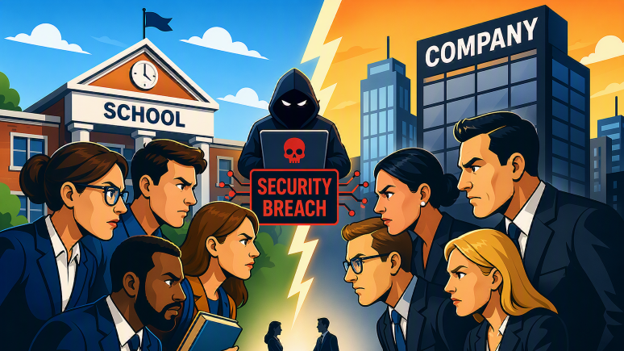
When a major education technology company is breached, the pattern is predictable: fear, then anger, then blame.
The fear is justified. Education systems hold highly sensitive student data, and recent incidents have shown how quickly damage can ripple outward. PowerSchool’s breach exposed data from tens of millions of students and educators. The perpetrator was later identified and prosecuted, but the consequences—data exposure, follow-on extortion attempts, and erosion of trust—did not simply disappear.
In spring 2026, Instructure disclosed a major cybersecurity incident affecting Canvas, one of the most widely used learning platforms in the world. While the company reported that names, email addresses, student ID numbers, and user messages were involved, it also stated there was no evidence that passwords, financial data, or government identifiers were compromised.
Other vendors, including Illuminate Education and others across the sector, have also faced scrutiny, investigations, and in some cases settlements tied to data practices and breach exposure. The pattern is not isolated. It is systemic.
And that is the point.
This Is Not a Vendor Problem. It Is a System Condition.
Schools do not simply purchase software. They embed it into the core operating system of learning:
- identity
- communication
- assessment
- records
- instruction
In effect, schools hire co-responsibility.
That does not reduce vendor accountability. The safety and continuity of education now depend on shared execution across institutions and their technology partners.
Cybersecurity data makes this reality unavoidable:
- A majority of districts report experiencing cybersecurity incidents in recent years
- Vendor-related incidents are rising as systems become more interconnected
- K–12 environments are now among the most targeted sectors for cyberattacks
This is no longer episodic risk. It is an operating condition.
The Wrong Response: Public Othering
When a breach happens, the instinct to isolate and blame the vendor is understandable—but ultimately unproductive.
Public outrage does not:
- reduce attack surfaces
- improve identity governance
- tighten procurement discipline
- strengthen contracts
- accelerate coordinated response
Instead, leaders across the sector are increasingly calling for the opposite:
- stronger district–vendor collaboration
- clearer shared accountability
- more disciplined architecture and oversight
The reality is simple: in an interconnected system, failure is shared whether we admit it or not.
The Required Response: Leadership and Sequence
This is where maturity shows.
A mature organization stabilizes and investigates first, then assigns responsibility clearly and improves the system without turning crisis communication into public spectacle.
That is not avoidance. That is governance.
Accountability matters. But sequence matters more:
- Stabilize and protect operations
- Understand what actually happened
- Fix exposure and prevent recurrence
- Clarify responsibility
- Strengthen the system
Leadership does not begin with distancing. It begins with stewardship.
Human Systems Fail. Build for That Reality.
It is tempting to believe that failures signal incompetence alone. The truth is harder:
- attackers exploit human error
- credentials get compromised
- systems grow complex beyond single-point visibility
- interdependencies multiply risk
The PowerSchool breach involved compromised credentials and insufficient access control. The Canvas incident involved unauthorized access that required credential revocation, patching, and forensic response. These are not identical failures—but both are examples of something deeper:
modern systems are complex, and complexity creates vulnerability.
The solution is not denial or theater. It is disciplined system design.
Shared Responsibility Is Not Optional
Districts also carry responsibility.
It is not tenable to demand:
- real-time data
- deep integrations
- personalized learning systems
- parent communication platforms
- open APIs
…and then assume vendors alone hold the full burden when something fails.
Shared responsibility means:
- stronger procurement standards
- identity discipline (including MFA everywhere)
- fewer redundant tools
- better data governance
- continuous audit and review
The expansion of edtech over the past decade has dramatically increased the attack surface—often without equivalent increases in security investment or staffing.
Ecosystems Mean Shared Risk
Education now runs on hub systems connected through APIs all over the place, not isolated systems:
- LMS platforms
- SIS systems
- assessment tools
- credential networks
- communication layers
- analytics pipelines
- courseware
- document, book, image, and video libraries
A breach in one widely used platform can cascade across thousands of institutions simultaneously. That is not hypothetical. It has already happened.
Treating vendors as external “others” ignores the structural reality: they are part of the system now. They are you; like a staff member.
The Path Forward: Better Systems, Not Less Trust
The answer is not less technology.
The answer is better-governed technology.
That means:
- fewer but stronger platforms
- tighter standards
- clearer accountability
- shared incident response discipline
- continuous improvement
It also means less emotional reaction and more operational leadership.
The Real Question
After a breach, it is easy to ask: “Who failed?”
But the more important question is: “How do we strengthen what we are together?”
Because modern education is no longer a set of independent organizations. It is a shared system serving students at scale.
A serious system:
- stabilizes
- learns
- corrects
- strengthens
—and continues forward.
Education needs that level of leadership now.
Endnotes
1] PowerSchool breach scale and impact: tens of millions of student and educator records compromised; credentials used to access support systems. [\[eschoolnews.com\]](https://www.eschoolnews.com/innovation-insights/2025/07/23/eschoolnews-live-instructurecon25/), [\[prnewswire.com\]](https://www.prnewswire.com/news/instructure/) \[2] PowerSchool attacker identified and prosecuted; breach involved long-term exposure risk and ongoing extortion concerns. [\[prnewswire.com\]](https://www.prnewswire.com/news/instructure/) \[3] Instructure / Canvas incident (2026): unauthorized access with exposure of names, emails, student IDs, and messages; no evidence of passwords or financial data compromised. [\[techedgeai.com\]](https://techedgeai.com/instructure-unveils-igniteai-to-bring-context-aware-ai-to-canvas-for-educators/), [\[instructure.com\]](https://www.instructure.com/news/public-relations) \[4] K–12 cybersecurity trend: over half of districts reported incidents in 2025, with significant increase in vendor-related exposure. [\[instructure.com\]](https://www.instructure.com/press-release/instructure-delivers-safe-simple-ai-promise-igniteai-and-major-ecosystem-updates) \[5] RAND findings: approximately 60% of schools experienced cybersecurity incidents across recent school years. [\[forbes.com\]](https://www.forbes.com/sites/rayravaglia/2025/07/23/instructure-and-openai-harness-the-power-of-ai-to-transform-learning/) \[6] Growing reliance on edtech increases attack surface; majority of core school operations now depend on software platforms. [\[CodeInterpreter \| Undefined\]]
\[7] Sector leadership perspective: need for stronger state–district–vendor collaboration and shared accountability in response to cybersecurity risk. [\[instructure.com\]](https://www.instructure.com/press-release/instructure-unveils-bold-vision-future-education-technology-preparing-educators-and)
***