Bold words, yes.
The education sector stands at a tipping point. Economic pressures are mounting, traditional funding models are cracking, and AI-powered tools are ready to reshape how students learn and teachers teach. The message to educators is direct but empowering: Adapt and lead the new model, or risk being displaced by it.
This article is about why, what education will look like if it wants to survive, what teaching will look like, and what you as a teacher have to learn.
There are new learning models emerging that largely replace live teaching. Most educators say, "That will never happen." But many don't see the financial and enrollment pressures driving these shifts.
At scale, cost-cutting ultimately means job loss.
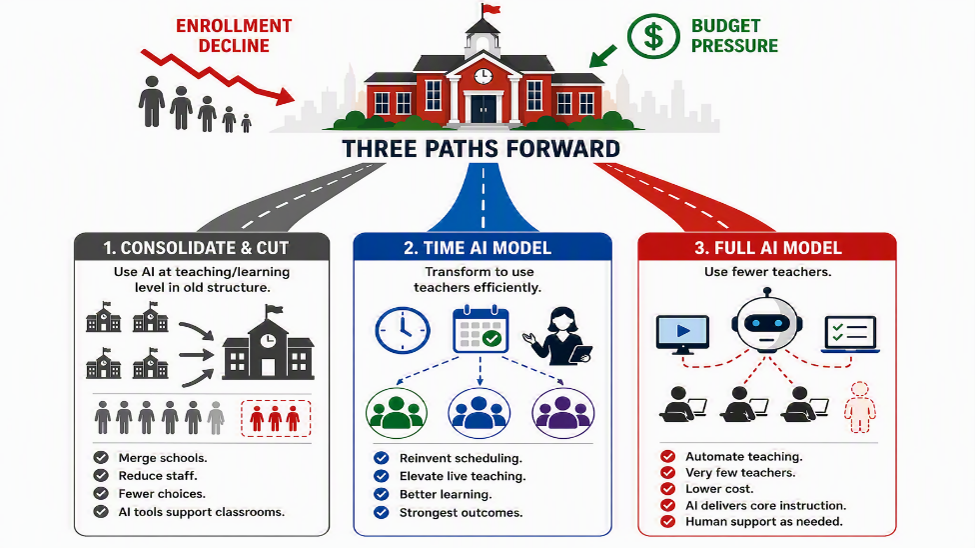
As a result, the emerging models are splitting into three camps:
- Districts consolidating schools and staff in a defensive effort to preserve traditional operations—a sort of educational "last stand."
- Fully AI-driven models that use very few teachers and rely heavily on automation.
- New hybrid models, such as Knowstory's Time AI, that reorganize learning around pace-based live teaching rather than the traditional master schedule.
And here's the challenge:
This ain't your daddy's master schedule.
Time AI doesn't ask how to fit students into fixed periods. It asks how to coordinate learning, pacing, and live teaching dynamically. The result feels unfamiliar at first because it's not an incremental improvement to the traditional schedule—it's a different operating system for learning.
Yet it doesn't replace teachers. It makes their live teaching more valuable.
It makes it so you’re far more preciously leveraged for exactly and only what you do best -- teach.
The Pressures Are Already Here
U.S. schools face tightening budgets amid slowing economic growth. Forecasters project modest GDP expansion around 2% for 2026, with risks of higher unemployment and consumer fatigue.
State and local funding—tied to taxes sensitive to downturns—will feel the strain.
History offers a clear warning. During and after the Great Recession, national per-pupil K-12 spending fell roughly 7%, with deeper cuts in many states. Districts lost hundreds of billions cumulatively, leading to larger class sizes, teacher reductions, deferred maintenance, and measurable declines in student test scores and college enrollment. Those cuts persisted for years.
What does -7% look like?
Example: New York City Public Schools (NYC DOE)
- Enrollment: ~800,000–850,000 students (largest in U.S.).
- Total Budget: ~$37–40+ billion (operating/general fund; one of the highest globally).
- 7% Cut: ≈ $2.6–2.8 billion.
- Teacher Jobs Impact: Roughly 26,000–28,000 positions (at $100k each). This is massive—equivalent to eliminating a mid-sized district’s entire workforce.
Example: Los Angeles Unified School District (LAUSD)
- Enrollment: ~389,000 students (2025-26).
- Total Budget: $18.8 billion (2025-26 adopted).
- 7% Cut: ≈ $1.316 billion.
- Teacher Jobs Impact: Roughly 13,000+ positions. (Note: The district already faces deficits and has discussed hundreds to thousands of layoffs/position eliminations amid enrollment declines.)
budget.lausd.org
ExampeE Example: Chicago Public Schools (CPS)
- Enrollment: ~300,000–320,000 students.
- Total Budget: Often ~$9–10+ billion in recent years (facing reported deficits in the $700M+ range in some cycles).
- 7% Cut (on a $9.5B base): ≈ $665 million.
- Teacher Jobs Impact: Roughly 6,500–7,000 positions.
Example: Miami-Dade County Public Schools (Florida)
- Enrollment: One of the top 10 largest (~300,000–350,000 students).
- Total Budget: Approximately $5–6 billion range (Broward County nearby was ~$5B with a $90M deficit).
- 7% Cut (on $5.5B base): ≈ $385 million.
- Teacher Jobs Impact: Roughly 3,800–4,000 positions. Many large Florida districts are actively managing cuts due to enrollment and inflation pressures.
chalkbeat.org
ExampleExample: Small/Rural Example like USD 286 Chautauqua or typical rural)
- Enrollment: 500–2,000 students (common for small districts).
- Total Budget: $10–30 million (varies widely; many operate on $15–25M).
- 7% Cut (on $20M base): $1.4 million.
- Teacher Jobs Impact: Roughly 14 positions (devastating for a small district—could mean consolidating schools, larger classes, or eliminating programs/specialists). Many small districts have tight margins and rely heavily on state aid.
Today, similar dynamics are emerging. Edtech is knocking on the door with transformative solutions to structure, not just tack-on for curriculum or better financial, HR or major systems. Edtech itself shows robust long-term growth projections (U.S. market moving from tens of billions toward hundreds of billions by the mid-2030s), but overall education budgets are not immune to broader economic headwinds. Thousands of small edtech companies will fail alongside the predicted big hit to school budgets.
Yet when money gets tight, labor costs—the largest line item—come under scrutiny. Teacher shortages in key areas already exist, yet many traditional positions remain vulnerable to efficiency-driven consolidation.
A Concrete Vision of the Future: Networked Microschools and Hybrid Rotations
The future of education will not be massive layoffs in a vacuum. It will be a leaner, more effective system built around networked microschools and hybrid in-person rotations.
Imagine clusters of small schools, each serving 50–150 students. These microschools connect into larger networks sharing resources, expertise, and AI platforms. Teachers specialize and rotate—sometimes in-person, sometimes virtually—across locations or cohorts.
- Hybrid Schedule Model: In-person days emphasize mentoring, hands-on projects, labs, discussions, and social-emotional development. Remote/hybrid days leverage AI for personalized instruction, adaptive practice, real-time feedback, and assessment. One highly effective teacher, amplified by AI, can support far more students without sacrificing quality.
- Cost Reductions That Enable Survival:
- Dramatically lower transportation expenses (fewer daily commutes to large centralized campuses).
- Reduced facilities and overhead costs through smaller, distributed footprints.
- Staffing efficiency: Optimized models can deliver equivalent or better outcomes at 20–40% lower per-student labor costs in targeted areas, according to patterns in early hybrid and personalized pilots.
This structure increases personalization—AI tailors pace, content, and support to each child—while preserving the human elements teachers do best. Students in rural or underserved areas gain access to top-tier expertise through the network. Districts stretch limited dollars further without simply cutting programs.
Why Teachers Must Lead This Shift
The choice is not "lose your job or fight all change." It is "Shape the reinvention of teaching, or let it happen without you."
Teachers who step up will thrive. Roles will evolve toward:
- Master facilitators and mentors
- Curriculum designers who work with AI
- Rotation specialists managing hybrid cohorts
- Leaders of individual microschools
These positions reward expertise, creativity, and relationship-building. Top performers can reach more students and command premium compensation. Burnout decreases as AI handles rote tasks like basic grading and drill practice.
Early signals of this transformation already exist: growing adoption of adaptive learning platforms, hybrid experiments in districts facing enrollment or budget challenges, and rising interest in microschool models post-pandemic. AI segments within edtech are among the fastest-growing precisely because they promise scalability and results amid funding constraints.
Risks and the Path Forward
This transition carries challenges. Not every teacher will transition easily—training, digital equity, and preserving student well-being matter. Unions, districts, and policymakers should invest in reskilling, pilot programs, and fair transition support rather than resisting innovation. Quality controls and evidence-based implementation are essential so that efficiency does not come at the expense of outcomes.
Yet the alternative—clinging to legacy models amid shrinking budgets—risks worse outcomes: larger classes, fewer electives, and declining resources that ultimately harm students and job security alike.
The Opportunity Ahead
Economic pressure is forcing efficiency. Smart adaptation turns that pressure into progress. Networked microschools with hybrid rotations, powered by AI, can deliver more personalized, resilient education at lower cost—while elevating the teaching profession.
Teachers have the experience, judgment, and passion students need most. Those who instigate and lead this new model will define the next era of American education. The revolution is coming. The only question is whether you help drive it.
Why Hybrid/Microschool Models Matter Here: Shifting even part of instruction to AI-hybrid rotations could offset a significant portion of these cuts by reducing per-student staffing needs while preserving (or improving) personalization.
Educators, administrators, and policymakers: The window to pilot, experiment, and lead is now. The future belongs to those who build it.
***