As school districts across America wrestle with artificial intelligence policy, implementation, professional development, and governance, many are discovering that AI adoption is less about technology than leadership.
I was fortunate recently to have a catch-up call with a long-time friend, Dr. Sherri N. Wilson. We chatted about AI and I introduced my new book aiming at a way to elevate the missing seven domains of human intelligence, the ones that aren’t math and science, as one answer to the AI incursion. After AI: What Human Intelligence Actually Is--is available for download here just by signing up at Learning Counsel.
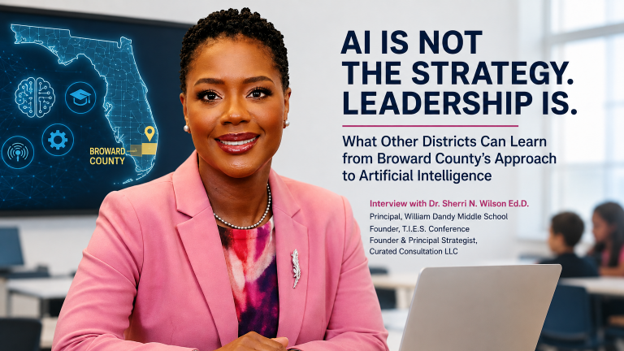
For my friend, Dr. Sherri N. Wilson, recently appointed principal of William Dandy Middle School and former Director of Innovative Learning for Broward County Public Schools, the nation's 6th largest school district, the challenge was never simply introducing AI tools. It was building the structures, trust, and shared vision necessary to deploy them responsibly.
In our talk, Wilson reflected on the work of leading Broward's Artificial Intelligence Task Force and the lessons she believes districts nationwide should consider as AI moves from experimentation to institutional practice.
"AI is not the strategy," Wilson said. "Leadership is the strategy. The technology changes rapidly, but the responsibility to guide people through change remains constant."
That perspective emerged from a two-year effort that saw Broward County Public Schools establish one of the nation's more comprehensive district-wide approaches to artificial intelligence. After being assigned the task of leading the AI Task Force in November 2024, Wilson collaborated and led this districtwide effort to create guidelines that developed ethical and responsible-use, established governance structures, authored a formal board resolution on AI, and built an implementation network of more than 200 AI liaisons across schools.
Yet Wilson is quick to caution that districts should avoid focusing exclusively on the technology itself.
"Many organizations start with the tool," she explained. "The better starting point is asking what problem you're trying to solve, what outcomes you're trying to improve, and how you'll ensure the work remains grounded in ethics and learning."
Governance Before Gadgets
One of the clearest themes from Wilson's experience is the need for governance before widespread deployment.
As generative AI tools entered classrooms and workplaces at unprecedented speed, many school systems found themselves reacting rather than planning. According to Wilson, the districts that will be most successful are those willing to establish guardrails early.
"Intellectual property matters. Privacy matters. Transparency matters," she said. "These conversations cannot happen after implementation. They must happen before implementation."
The result in Broward was the development of district-wide ethical and responsible-use guidance designed to provide educators and students with clear expectations while still encouraging innovation.
The lesson for other districts is straightforward: create policy frameworks before scale creates problems.
The Missing Ingredient: Distributed Leadership
Wilson believes one of the greatest misconceptions about AI implementation is the belief that central office teams can drive change alone.
District strategy, she argues, succeeds only when it becomes school-level practice.
To bridge that gap, Broward created an AI Liaison Cohort composed of educators from across the district who could bring local perspectives into district planning while carrying implementation back to individual campuses.
"The work has to be translated," Wilson said. "District offices create direction, but schools create reality."
That distributed leadership model helped move AI conversations beyond compliance and toward practical classroom application.
For many districts, this may be the most overlooked aspect of AI readiness. Purchasing technology is relatively easy. Building a network of informed educators capable of guiding change is substantially harder.
Why Professional Learning Must Change
Wilson's commitment to collaborative learning eventually expanded beyond district operations.
Recognizing the growing need for educators, aspiring administrators, and education technology professionals to learn together, she founded the Technology Innovation Ethics and Support Conference, known as T.I.E.S.
The conference was designed around a simple premise: no single stakeholder group possesses all the answers.
"Teachers, leaders, technology providers, and students all bring different perspectives," Wilson explained. "When those perspectives remain isolated, innovation slows. When they come together, solutions emerge."
The model reflects a broader shift occurring throughout education. Rather than viewing professional development as a one-way transfer of information, leading districts are increasingly creating collaborative ecosystems where participants learn from one another while confronting emerging challenges.
Artificial intelligence, perhaps more than any educational innovation in recent memory, demands that approach.
Student Voice in the Age of AI
While much of the national conversation has focused on teacher adoption and district policy, Wilson believes the ultimate objective must remain student growth.
"The goal isn't to create students who know how to use AI," she said. "The goal is to create students who know how to think."
That distinction may prove critical as schools attempt to prepare learners for a future in which information is abundant and AI-assisted work becomes commonplace.
Wilson argues that ethical reasoning, creativity, critical thinking, and human judgment will become increasingly valuable precisely because machines can perform many routine cognitive tasks.
In her view, the challenge facing educators is helping students learn how to lead technology rather than allowing technology to lead them.
A New Chapter, A Familiar Mission
After helping shape district-wide AI strategy, Wilson now returns to the school level as principal.
The move represents what she calls a "reverse scaling" opportunity—taking lessons learned from systemwide implementation and applying them directly to the students and teachers who experience educational transformation most closely.
"The work becomes real in classrooms," she said. "That's where the impact happens."
For districts still determining their AI roadmap, Wilson offers a simple framework:
- Start with ethics.
- Build governance.
- Invest in people.
- Create distributed leadership.
- Keep students at the center.
Artificial intelligence may be the catalyst for change, but according to Wilson, the future of education will ultimately be determined by something far more familiar:
Human leadership.
As districts nationwide continue navigating the opportunities and challenges of AI, that may be the lesson worth remembering.
***